How to Select a Gearbox for Industrial Conveyors
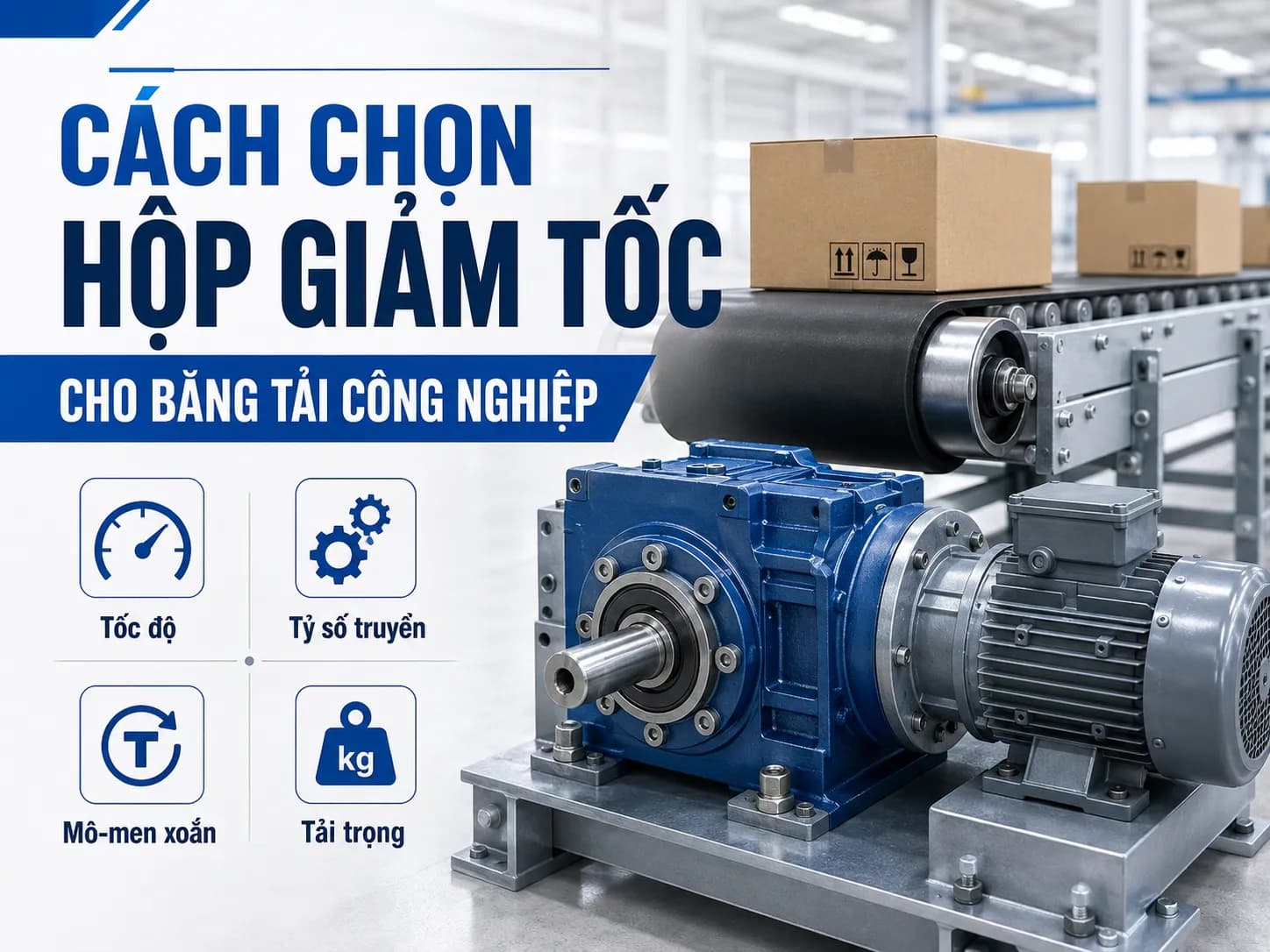
To select a gearbox for an industrial conveyor, you must determine motor power, conveyor speed, gear ratio, torque, load, operating hours, mounting style, and working environment. Do not select based solely on motor power, as this often leads to insufficient traction or gearbox overload.
How to Select a Gearbox for Industrial Conveyors
What is a Conveyor Gearbox?
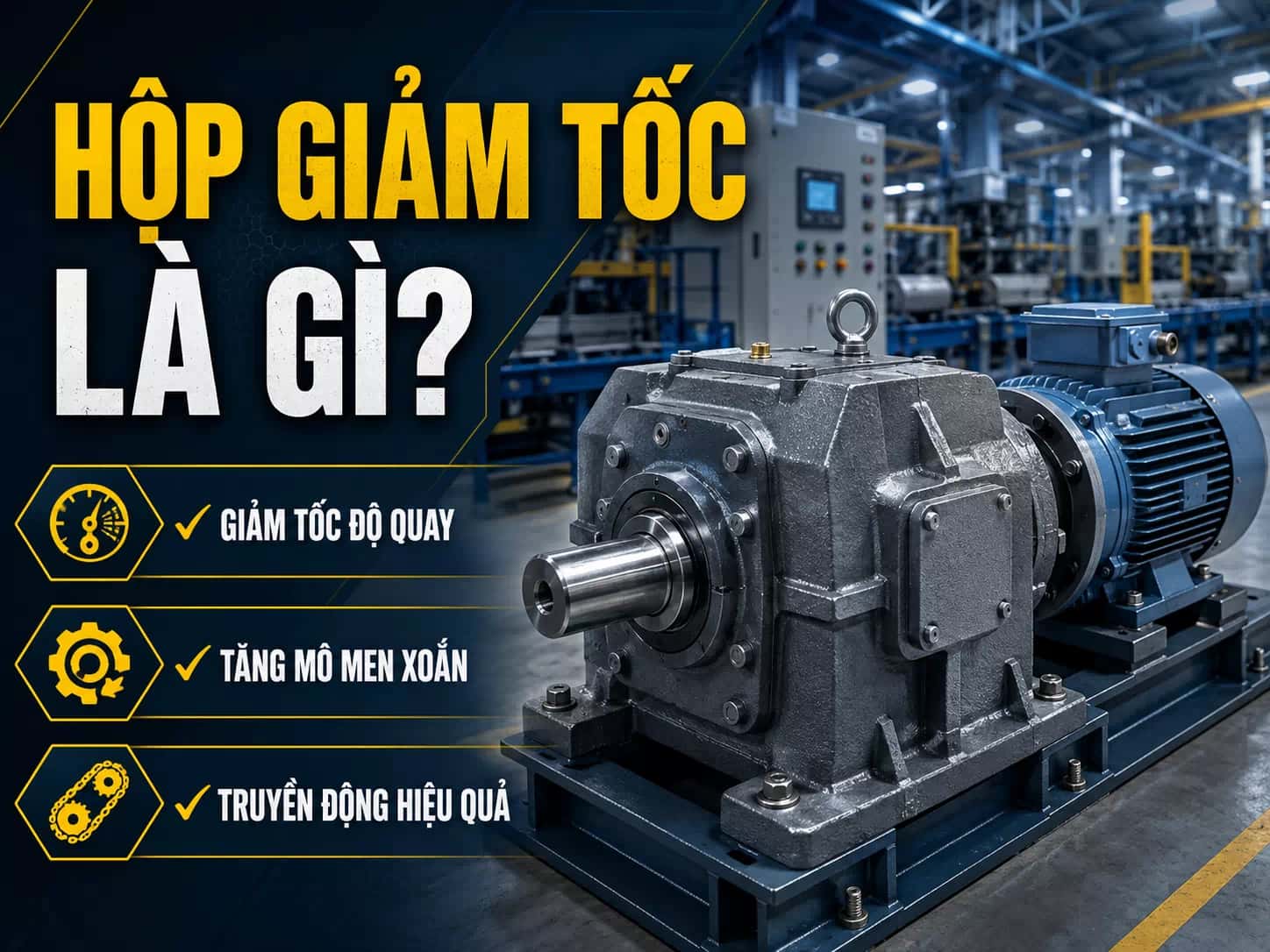
A conveyor gearbox is a transmission device installed between the electric motor and the conveyor drive pulley. Its function is to reduce the rotational speed from the motor and increase torque to ensure the conveyor operates stably.
In industrial conveyor systems, motors typically run at high speeds, for example, 1,450 rpm for a 4-pole motor. However, the actual required speed of the conveyor is often much lower. Therefore, a gearbox is necessary to bring the output speed to a level suitable for material handling requirements.
Gearboxes for conveyors are commonly used in:
Light-duty conveyors
Carton conveyors
Food industry conveyors
Packaging conveyors
Logistics conveyors
Mining conveyors
Cement conveyors
Heavy-duty industrial plant conveyors

Image of a motor and gearbox installed on an industrial conveyor system, demonstrating the role of speed reduction and torque multiplication for conveyor drives.
Why Do Conveyors Need a Gearbox?
Conveyors require a gearbox because electric motors typically rotate at high speeds, but the direct pulling force is not suitable for the actual transport speed. A gearbox helps reduce output speed, increase torque, and helps the conveyor run more stably.
If the wrong gearbox is selected, the conveyor may face issues such as:
Running too fast or too slow
Inability to pull the load
Motor overload
Gearbox overheating
Conveyor jerking during startup
Drive pulley vibration
Rapid gear wear in the gearbox
Production line downtime for repairs
For industrial conveyors, selecting the correct gearbox from the start will help reduce the risk of failure and increase the service life of the entire drive system.
Parameters to Know Before Selecting a Conveyor Gearbox
Before selecting a gearbox, you need to prepare the following technical information:
Motor power currently in use
Motor speed, e.g., 1,450 rpm
Desired conveyor speed
Diameter of the drive pulley / roller
Load capacity on the conveyor
Conveyor length and width
Conveyor incline angle (if applicable)
Daily operating hours
Start/stop frequency
Load type: light, medium, heavy, shock load
Gearbox mounting style
Working environment
Noise level requirements
Investment budget
Brand or origin requirements
If these parameters are missing, selecting a gearbox is often just an estimation and may not be suitable for the actual load.
Image Prompt

Checklist image of parameters needed when selecting a gearbox for industrial conveyors such as motor power, speed, gear ratio, torque, and load.
How to Calculate the Gearbox Ratio for Conveyors
The gear ratio is a very important parameter when selecting a gearbox. The gear ratio indicates how many times the gearbox will reduce the motor speed.
Basic formula:
Gear Ratio = Motor Speed / Desired Output Speed
Example:
The motor has a speed of 1,450 rpm. If an output speed of approximately 72 rpm is needed, the required gear ratio is:
1,450 / 72 ≈ 20
Thus, you can choose a gearbox with a gear ratio of approximately 1/20.
Some common gear ratios for conveyors:
1/10: higher output speed
1/20: commonly used for many conveyors
1/30: slower speed, higher pulling force
1/40: suitable for heavier loads
1/50 and above: used when very slow speeds or high torque are required
However, do not select based solely on the gear ratio. You should also check the output torque and the load-bearing capacity of the gearbox.

Infographic on how to calculate the gearbox ratio for industrial conveyors based on a 1450 rpm motor speed and the desired output speed.
How to Calculate Conveyor Speed from Output Speed
Conveyor speed depends on the rotational speed of the drive pulley and the pulley diameter. If the pulley has a large diameter, the same rotational speed will create a higher conveyor speed.
Reference formula:
Conveyor Speed = Pulley Circumference x Pulley Rotations per Minute
Where:
Pulley Circumference = 3.14 x Pulley Diameter
Example:
Pulley diameter: 100 mm = 0.1 m
Gearbox output speed: 72 rpm
Pulley circumference: 3.14 x 0.1 = 0.314 m
Conveyor speed: 0.314 x 72 = 22.6 m/min
Thus, with a 1,450 rpm motor, a 1/20 gear ratio gearbox, and a 100 mm pulley, the conveyor speed is approximately 22.6 m/min.
This is the basic calculation method to check conveyor speed before selecting a gearbox.
How to Select Torque for a Conveyor Gearbox
Torque is the rotational force at the gearbox output. The heavier, longer, or more inclined the conveyor is, the more torque is required.
Factors that increase the required torque:
Heavy cargo load
Long conveyor
Inclined conveyor
High friction
Frequent starts
Shock loads
Sticky, heavy, or uneven cargo
Dusty, humid, or high-temperature environments
If the torque is insufficient, the conveyor may not start under load, run weakly, cause the motor to overheat, or lead to premature gearbox failure.
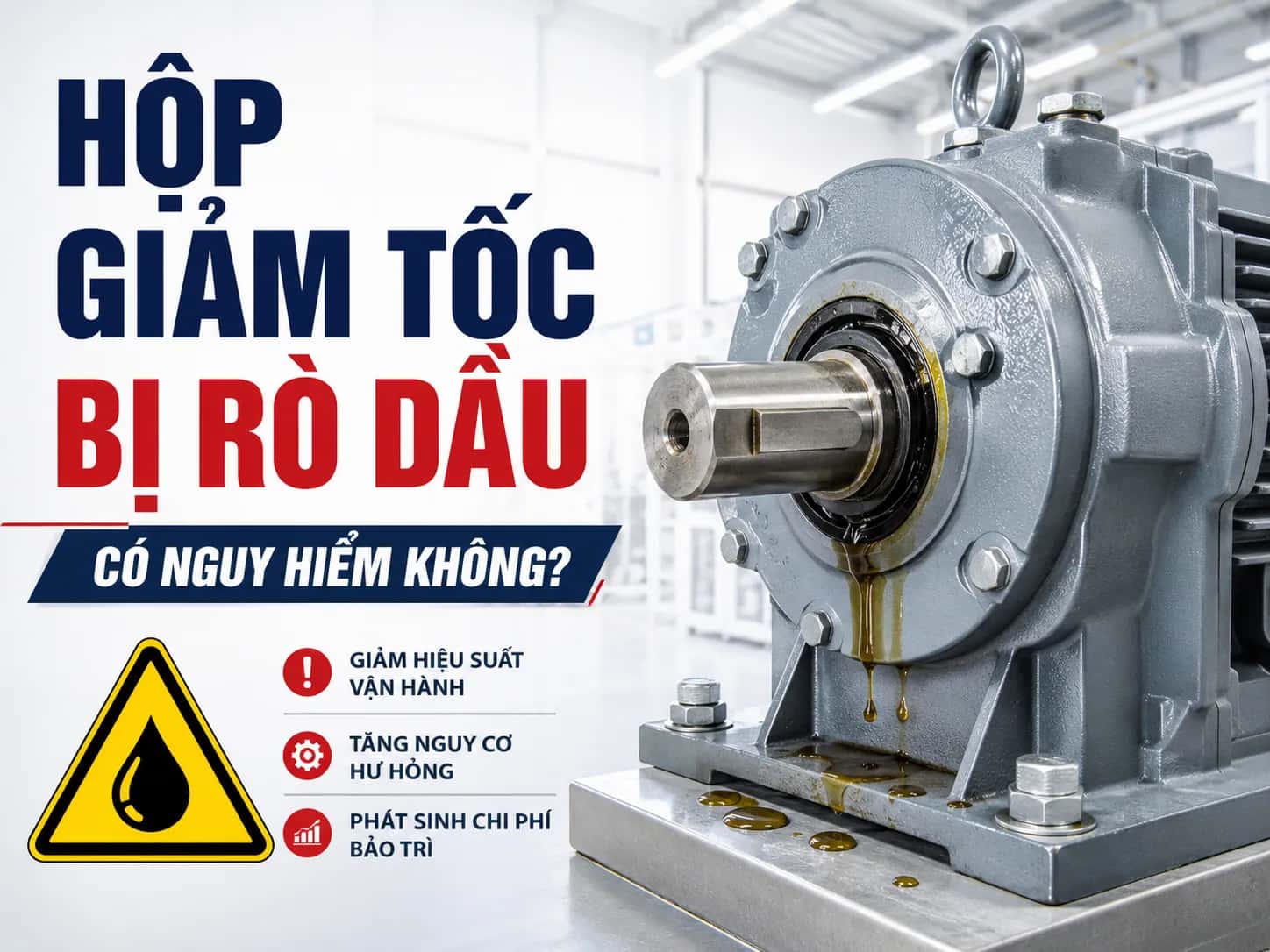
When selecting a gearbox, check the allowable output torque in the catalog, not just the motor power.
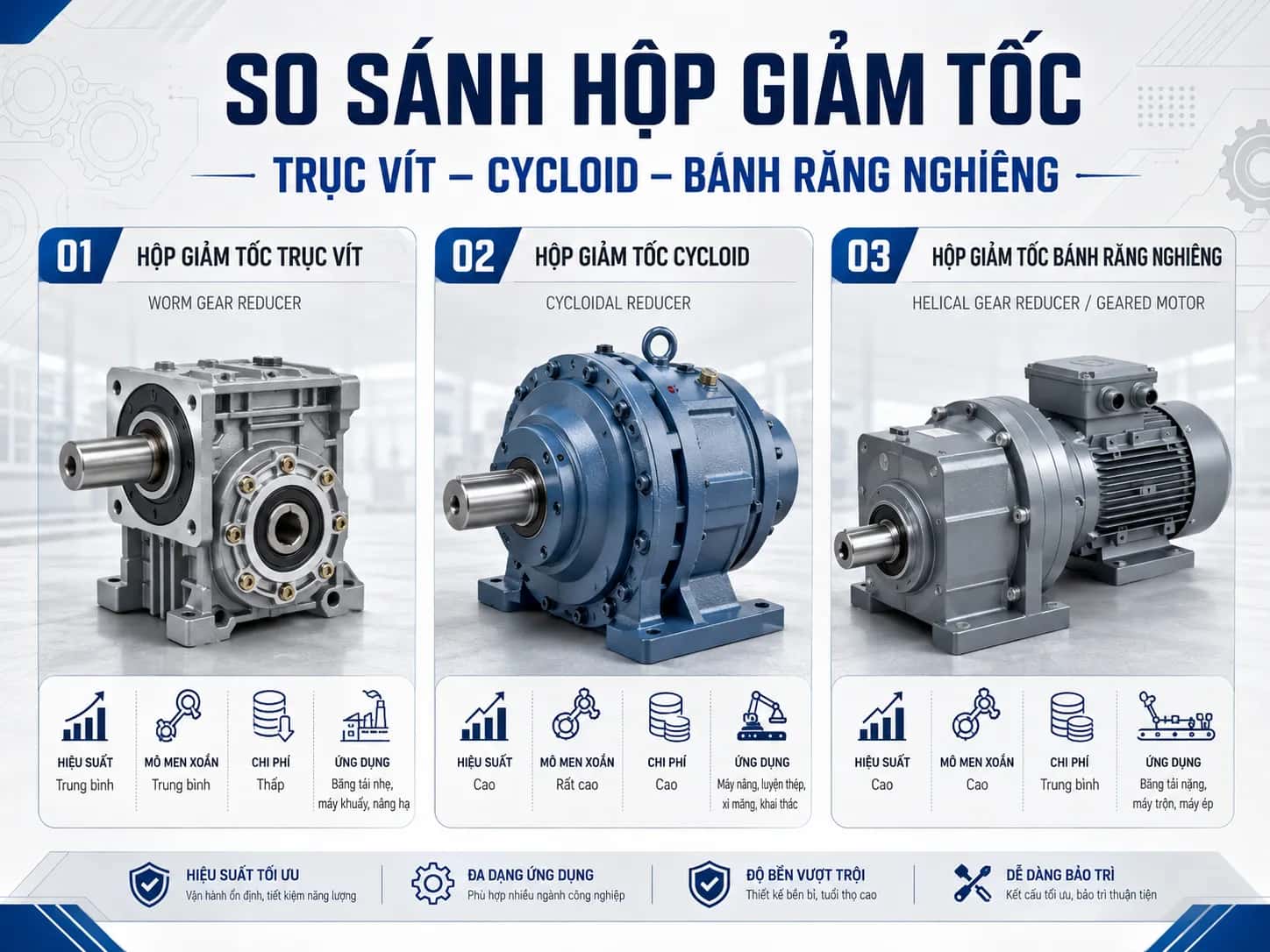
Which Type of Gearbox Should You Choose for a Conveyor?
There are many types of gearboxes that can be used for conveyors. Each type is suitable for a different group of applications.
1. Worm Gearbox for Conveyors
Worm gearboxes are suitable for light to medium-duty conveyors that require a compact design, right-angle transmission, and reasonable cost.
Advantages:
Compact, easy to install
Reasonable price
Suitable for tight spaces
Right-angle transmission
Good for small conveyors
Suitable applications:
Carton conveyors
Light food conveyors
Packaging conveyors
Small feed conveyors
Auxiliary equipment
Do not use a worm gearbox for very heavy-duty conveyors or those running under constant overload without carefully checking the torque and operating temperature.

Image of a worm gearbox installed on a small conveyor, suitable for light to medium-duty applications and limited installation space.
2. Helical Gearbox for Conveyors
Helical gearboxes are suitable for industrial conveyors that run continuously, requiring high efficiency, smooth operation, and long-term durability.
Advantages:
High transmission efficiency
Smooth operation
Low vibration
Suitable for continuous operation
Good load capacity
Long service life if the correct load is chosen
Suitable applications:
Continuous production conveyors
Logistics conveyors
Food conveyors
Packaging conveyors
Automated line conveyors
Medium to heavy-duty conveyors
If the conveyor is the main equipment in the line, a helical gearbox is usually a better long-term choice.
3. Cycloidal Gearbox for Heavy-Duty Conveyors
Cycloidal gearboxes are suitable for heavy-duty conveyors, shock-load applications, or systems requiring high torque.
Advantages:
Good shock load resistance
High torque
Robust construction
Suitable for heavy loads
Works well in heavy industrial environments
Suitable applications:
Mining conveyors
Cement conveyors
Bulk material conveyors
Heavy-duty conveyors
Conveyors with shock loads
Material handling systems
If the conveyor frequently starts under load or transports heavy materials, a cycloidal gearbox is a choice worth considering.
Selecting a Gearbox Based on Conveyor Load
You can make a preliminary selection based on load levels as follows:
Conveyor Type | Load Characteristics | Suggested Gearbox |
|---|---|---|
Light-duty | Small items, even load, minimal shock | Worm or small helical gearbox |
Medium-duty | Cartons, packaging, industrial products | Helical or high-quality worm gearbox |
Heavy-duty | Heavy materials, high load, continuous run | Helical or cycloidal gearbox |
Shock-load | Variable load, frequent starts | Cycloidal or high service factor gearbox |
Inclined | Requires higher pulling force | Helical, cycloidal, or worm with torque check |
This table is for initial reference only. When selecting, you still need to calculate speed, torque, service factor, and operating conditions.
Common Mistakes When Selecting a Conveyor Gearbox
1. Selecting Based Only on Motor Power
This is the most common mistake. For example, seeing a 1.5 kW motor and choosing a 1.5 kW gearbox without checking the gear ratio, torque, output speed, and conveyor load. This approach can lead to insufficient traction or rapid overload.
2. Incorrect Gear Ratio
If the gear ratio is too small, the conveyor runs too fast and has weak pulling force. If the gear ratio is too large, the conveyor runs too slowly, potentially failing to meet required productivity.
3. Not Calculating Startup Load
Conveyors may require higher torque during startup, especially if starting while loaded. If this factor is not considered, the motor and gearbox are prone to overload.
4. Not Checking Mounting Style
You must carefully check the mounting style:
Foot mount
Flange mount
Hollow shaft
Solid shaft
Parallel shaft
Right-angle shaft
Motor orientation
Shaft diameter
Bolt hole spacing
If the wrong mounting style is chosen, the gearbox may not fit the existing conveyor frame.
5. Choosing an Undersized Gearbox to Save Costs
Choosing a smaller gearbox than required may reduce initial costs but increases the risk of overheating, oil leaks, gear wear, bearing failure, and production line downtime.
Checklist for Selecting a Conveyor Gearbox
Before purchasing a gearbox for a conveyor, you should check:
What is the conveyor used to transport?
What is the maximum load capacity?
Does the conveyor run horizontally or inclined?
What is the desired conveyor speed?
What is the power of the motor in use?
What is the motor speed in rpm?
What gear ratio is needed?
What is the required output torque?
How many hours per day does the gearbox run?
Is there frequent starting/stopping?
Are there shock loads?
Is the environment dusty, humid, hot, or chemical-laden?
Is foot or flange mounting required?
Is a hollow or solid shaft needed?
Is it necessary to replace it with the exact dimensions of the old gearbox?
If replacing an old gearbox, take clear photos of the nameplate, shaft dimensions, mounting style, and overall appearance to select the correct equivalent model.
Example of Selecting a Conveyor Gearbox
Assume the system has the following parameters:
Motor: 1.5 kW
Motor speed: 1,450 rpm
Desired output speed: approx. 72 rpm
Pulley diameter: 100 mm
Conveyor carrying medium-load cartons
Operation: 8 hours/day
Calculate gear ratio:
1,450 / 72 ≈ 20
You can choose a gearbox with a 1/20 gear ratio.
Calculate conveyor speed:
Pulley circumference = 3.14 x 0.1 = 0.314 m
Conveyor speed = 0.314 x 72 = 22.6 m/min
For medium-load applications running 8 hours/day, you can consider a helical gearbox or a high-quality worm gearbox, depending on cost requirements, installation space, and desired durability.
If the conveyor runs continuously, has heavier loads, or requires high stability, a helical gearbox should be prioritized.
When Should You Use a VFD with a Conveyor Gearbox?
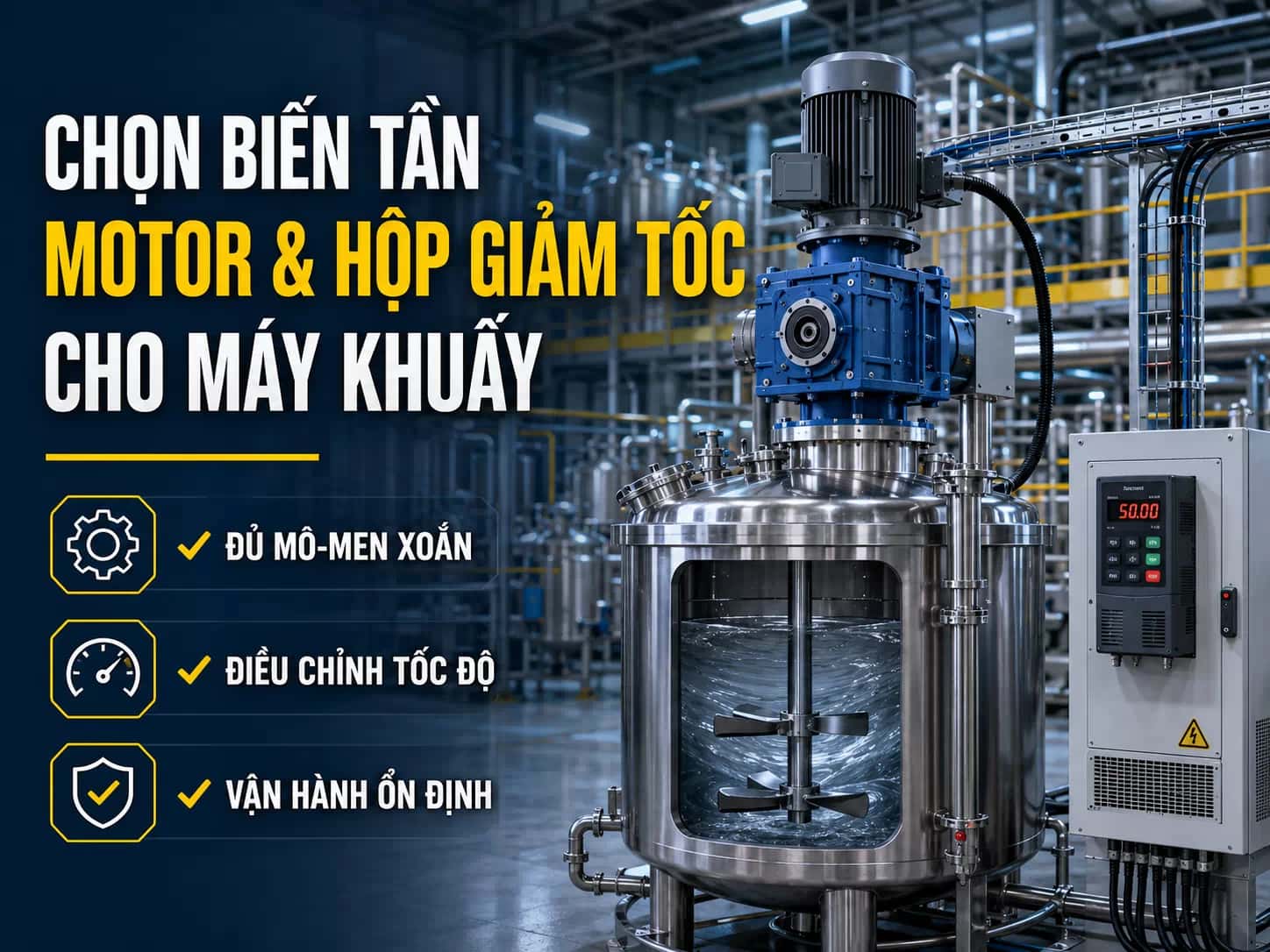
A VFD (Variable Frequency Drive) should be used when the conveyor requires flexible speed adjustment, soft starting, reduction of mechanical shock, or synchronization with the production line.
Benefits of using a VFD:
Adjust conveyor speed
Smoother startup and shutdown
Reduce load shock during startup
Better motor protection
Easy synchronization with PLC, sensors, HMI
Can save energy in some applications
Increase flexibility for the production line
However, a VFD does not completely replace a gearbox. A gearbox is still necessary when the system requires high torque and low output speed.
FAQ – Frequently Asked Questions
Is selecting a conveyor gearbox based on motor power sufficient?
No, it is not. Motor power is only one part. You must also check the output speed, gear ratio, torque, conveyor load, operating time, and mounting style.
What gear ratio should be chosen for a 1450 rpm motor on a conveyor?
It depends on the desired output speed. If you need about 72 rpm, you can choose a 1/20 gear ratio. If you need a slower speed and higher pulling force, you can choose 1/30, 1/40, or higher.
Can a worm gearbox be used for a conveyor?
Yes. A worm gearbox is suitable for light to medium-duty conveyors that need a compact design and right-angle transmission. For heavy-duty or continuous operation, carefully check the torque and temperature.
Which type of gearbox should be used for heavy-duty conveyors?
For heavy-duty conveyors, prioritize helical or cycloidal gearboxes. These two types are generally more suitable for high torque requirements, high durability, and continuous operation.
Is it necessary to use a VFD for a conveyor?
A VFD should be used if you need speed adjustment, soft starting, mechanical shock reduction, or synchronization with an automation system. For conveyors running at a fixed speed, a VFD may not be mandatory.
Conclusion
To select a gearbox for an industrial conveyor, do not rely solely on motor power. You must determine the conveyor speed, gear ratio, torque, load, operating time, mounting style, and working environment.
For light-duty conveyors, you can choose a worm or small helical gearbox. For continuously running conveyors, prioritize a helical gearbox for higher efficiency and stability. For heavy-duty or shock-load conveyors, a cycloidal gearbox is a choice worth considering.
MDriveTech provides consulting for selecting gearboxes, geared motors, electric motors, and VFDs for industrial conveyors based on power, speed, gear ratio, load, and actual installation conditions.
Hotline: 0868 789 647
Email: [email protected]