What Is a Gearbox? Structure, Classification, and Industrial Applications
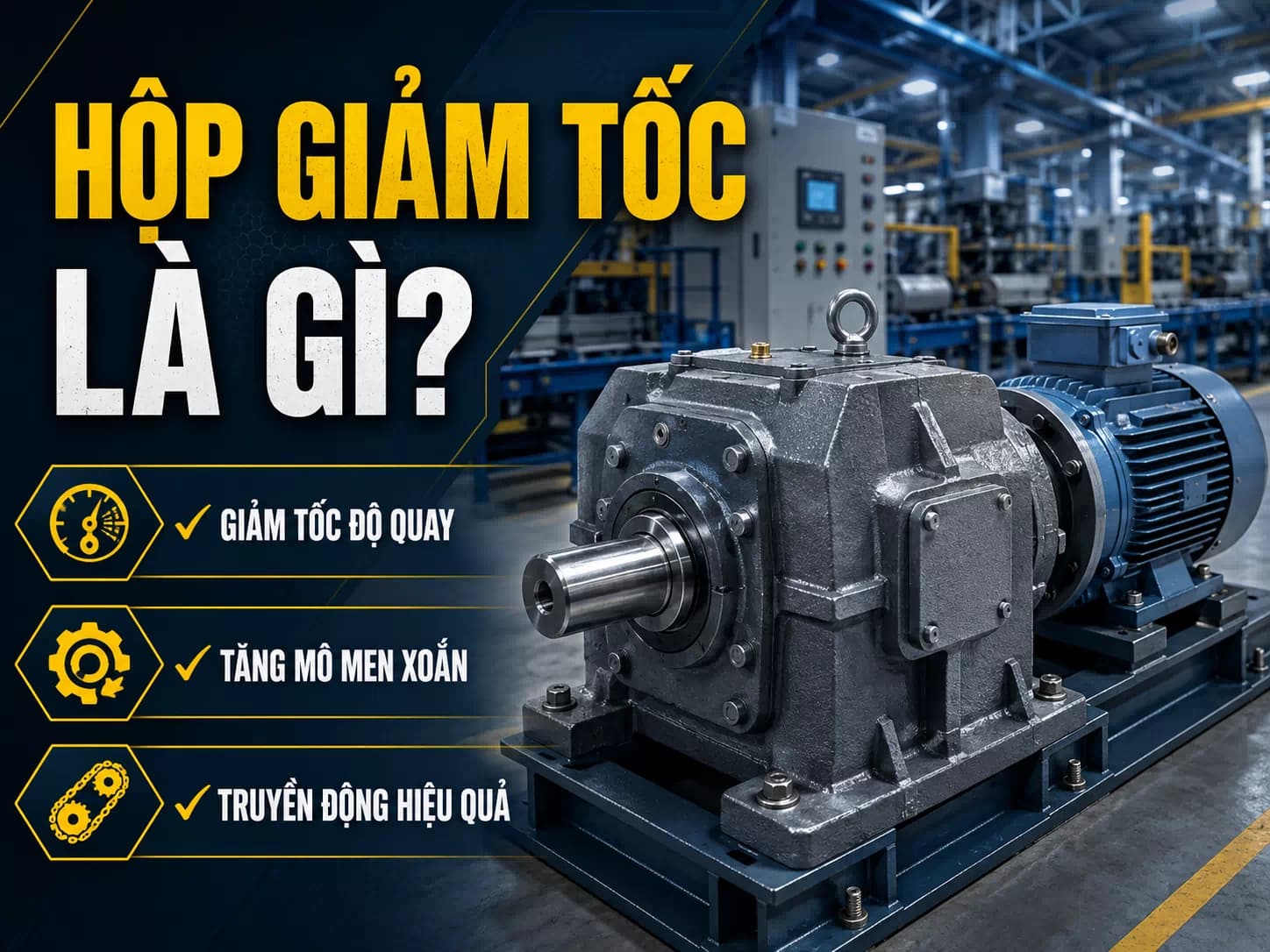
A gearbox is a mechanical transmission device used to reduce rotational speed and increase torque. Learn about its structure, operating principle, classification, and how to select the right gearbox.
What Is a Gearbox? Structure, Operating Principle, and Industrial Applications

A gearbox helps reduce rotational speed and increase torque for industrial transmission systems.
What Is a Gearbox?
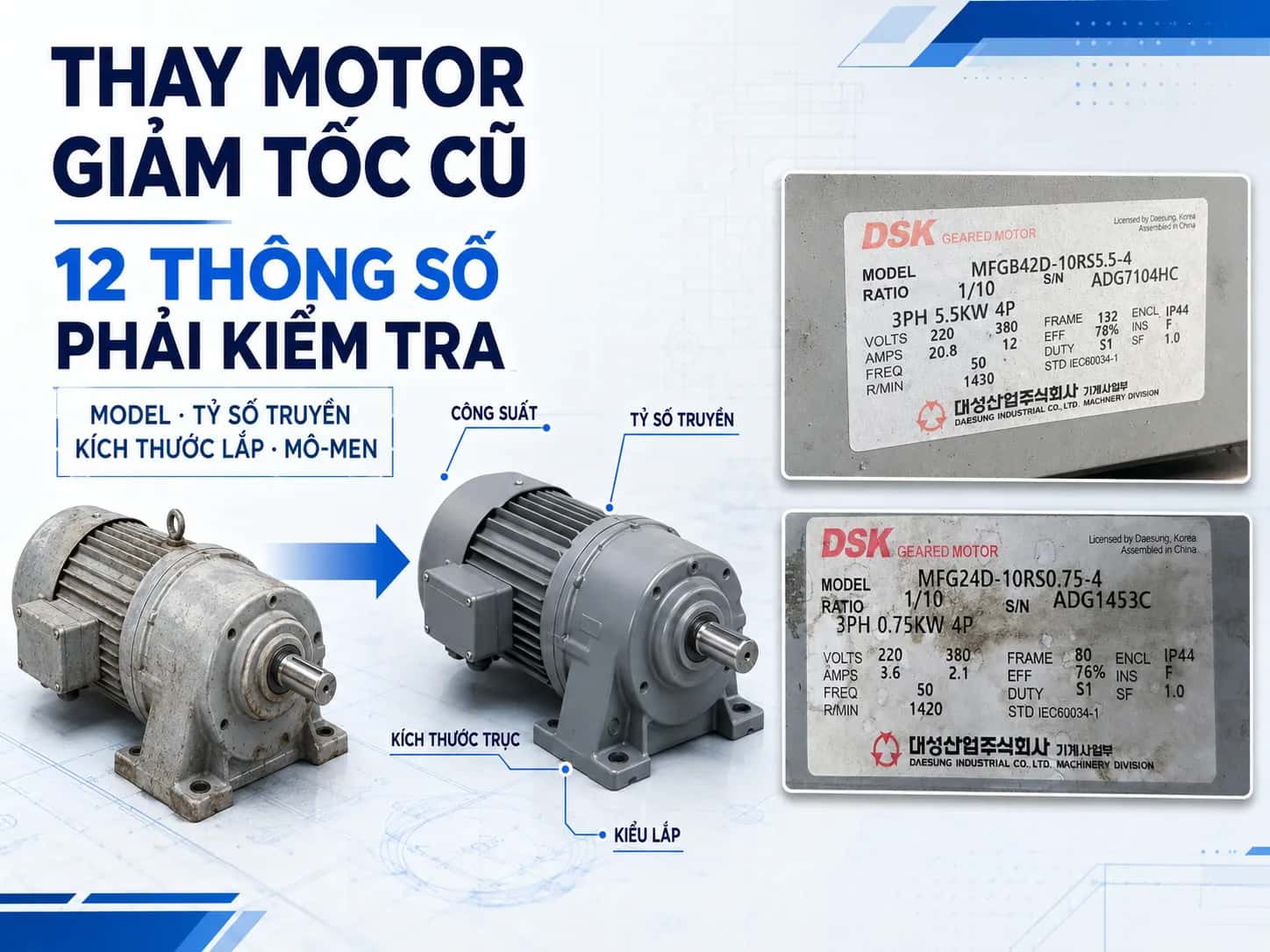
A gearbox is a mechanical transmission device used to reduce the rotational speed from an electric motor and increase the output torque before transmitting it to the load. In English, it is commonly referred to as a Gearbox, Speed Reducer, or Reduction Gearbox.
In industrial systems, electric motors typically operate at high speeds, commonly around 1450 rpm or 2900 rpm. However, many devices such as conveyors, agitators, mixers, screw conveyors, crushers, or lifting mechanisms require lower speeds but higher pulling force. In such cases, a gearbox is used to transform speed and torque to meet actual operational requirements.
Simply put, a gearbox helps reduce rotational speed while increasing output torque. This is why this device is considered one of the most critical components in industrial transmission systems.
Why Use a Gearbox?
Not every application can directly utilize the rotational speed of an electric motor. If the motor rotates too fast for the load's requirements, the system may experience vibration, overload, reduced mechanical lifespan, or fail to generate sufficient pulling force.
Gearboxes are used to address the following issues:
Reduce rotational speed from the motor to an appropriate level.
Increase output torque to drive heavy loads.
Ensure stable and smoother machine operation.
Protect the electric motor from mechanical overload.
Optimize the size and cost of the transmission system.
Easily integrate with VFDs, couplings, conveyors, mixers, crushers, and other industrial equipment.
For example, a 4-pole electric motor has a speed of approximately 1450 rpm. If a gearbox with a 1:50 gear ratio is used, the output speed will be reduced to about 29 rpm, while the torque will increase significantly to suit heavy loads.
Structure of a Gearbox
An industrial gearbox typically consists of precision mechanical components designed to transmit power, reduce speed, and withstand loads over long periods.

The main internal components of an industrial gearbox include gears, shafts, bearings, housing, and lubricating oil.
Gearbox Housing
The gearbox housing is usually made of cast iron, steel, or aluminum alloy depending on the power and application. The housing serves to protect internal components, retain lubricating oil, withstand mechanical stress, and assist in heat dissipation.
For heavy-duty applications such as cement conveyors, crushers, mixers, or mining, cast iron housings are preferred due to their high rigidity, excellent impact resistance, and stable operation.
Input Shaft
The input shaft is the component that receives motion from the electric motor. This shaft can be connected to the motor via a coupling, pulley, belt, or direct flange mounting.
The speed of the input shaft is usually equal to or nearly equal to the rotational speed of the electric motor.
Output Shaft
The output shaft is the component that transmits the reduced-speed motion to the load. Depending on the design, the output shaft can be a solid shaft, hollow shaft, right-angle shaft, or coaxial with the motor.
This is the position where high torque is generated to drive conveyors, rotate mixers, operate screw conveyors, or transmit power to industrial machinery.
Gears
Gears are the most important part of a gearbox. Through the meshing of gears with different sizes, the rotational speed is reduced and the torque is increased.
Common types of gears include:
Spur gears.
Helical gears.
Bevel gears.
Worm gears.
Planetary gears.
Cycloidal mechanisms.
The quality of gear machining directly affects the noise, efficiency, durability, and lifespan of the gearbox.
Bearings
Bearings support the shafts and help them rotate stably with low friction. If bearings are worn, dry, or damaged, the gearbox may produce loud noise, vibrate heavily, and overheat abnormally.
Oil Seals
Oil seals prevent lubricating oil from leaking out and stop dust, water, and impurities from entering the gearbox. This is a small but crucial component, especially in dusty, humid, or chemically harsh environments.
Lubricating Oil
Lubricating oil helps reduce friction between gears, cools internal components, and limits wear. Selecting the correct type of oil, the right viscosity, and periodic oil changes are key factors in extending the gearbox's lifespan.
Operating Principle of a Gearbox
The operating principle of a gearbox is based on the transmission between pairs of gears with different numbers of teeth and diameters. When a small gear drives a larger gear, the rotational speed decreases, and the torque increases.

A gearbox operates by reducing the rotational speed from the motor and increasing the torque at the output shaft.
The basic transmission process occurs as follows:
The electric motor generates high-speed rotational motion.
This motion is transmitted to the input shaft of the gearbox.
Internal gear stages reduce the rotational speed according to the gear ratio.
The output torque increases proportionally to the speed reduction.
The output shaft transmits power to the equipment requiring operation, such as conveyors, mixers, crushers, or screw conveyors.
For example, if the motor rotates at 1450 rpm and the gearbox has a 1:30 gear ratio, the theoretical output speed will be approximately 48 rpm. In practice, the output speed and torque also depend on the efficiency of each type of gearbox.
What Is a Gearbox Gear Ratio?
Gear ratio is a parameter indicating how many times the input speed is reduced compared to the output speed. The gear ratio is usually denoted as i or written in the format 1:10, 1:20, 1:50, 1:100.
Basic formula:
Output Speed = Input Speed / Gear Ratio
Example:
Motor Speed | Gear Ratio | Approximate Output Speed |
|---|---|---|
1450 rpm | 1:10 | 145 rpm |
1450 rpm | 1:20 | 72.5 rpm |
1450 rpm | 1:50 | 29 rpm |
1450 rpm | 1:100 | 14.5 rpm |
The higher the gear ratio, the lower the output speed and the higher the torque. However, one should not choose an excessively high gear ratio if not necessary, as it may reduce efficiency and increase the size of the gearbox.
Advantages of a Gearbox
Gearboxes are widely used in industry due to their ability to transmit power stably, increase torque, and meet various load requirements.
Increased Torque
This is the most important advantage. A gearbox helps increase output pulling force, allowing the electric motor to drive heavy loads without needing an excessively high-power motor.
Reduced Speed to Suit the Load
Many machines require low speeds for safe and stable operation. A gearbox helps bring the rotational speed to a level suitable for the actual application.
Protection of Motor and Transmission System
When selected correctly, a gearbox helps reduce the direct load on the motor, limits mechanical shock, and increases the durability of the entire transmission system.
Stable Operation
High-quality gearboxes are capable of smooth operation, low vibration, low noise, and are suitable for continuous production lines.
Diverse Mounting Styles and Applications
Gearboxes come in many mounting styles such as foot-mounted, flange-mounted, hollow shaft, right-angle shaft, parallel shaft, or coaxial, making them suitable for various machine spaces.
Disadvantages to Consider
Besides the advantages, there are some points to note when designing and operating a gearbox.
Requires Periodic Maintenance
Gearboxes contain mechanical parts such as gears, bearings, and oil seals, so they need to be inspected, lubricated, and have their oil changed periodically.
Efficiency Loss
No gearbox achieves 100% efficiency. During transmission, a portion of energy is lost in the form of heat, friction, and noise.
Potential Noise if Installed Incorrectly
If the gearbox is misaligned, lacks oil, is overloaded, or has worn gears, the device may produce loud noise and abnormal vibrations.
Increased Cost for Heavy Loads
Heavy-duty applications require larger gearboxes, better materials, and higher precision, thus increasing the investment cost.
Common Types of Gearboxes
There are many different types of gearboxes on the market today. Each type has its own structure, efficiency, transmission characteristics, and applications.
Spur Gearbox
A spur gearbox uses pairs of spur gears to transmit motion between parallel shafts. This type has high efficiency, a sturdy structure, and is suitable for many industrial applications.
Feature | Content |
Efficiency | High |
Load capacity | Good |
Durability | High |
Application | Conveyors, mixers, rolling mills, production machines |
Helical Gearbox
A helical gearbox has teeth machined at an angle to the axis of rotation. This design helps transmit motion more smoothly, reduces noise, and increases load-bearing capacity.
This type is often used in production lines requiring stable operation, low noise, and high efficiency.
Worm Gearbox
A worm gearbox consists of a worm and a worm wheel, typically used for applications requiring high gear ratios, compact size, and right-angle transmission.
Advantages | Disadvantages |
Compact structure | Lower efficiency than spur gears |
High gear ratio | Generates more heat |
Self-locking capability in some cases | Requires good lubrication |
Popular price | Not suitable for all continuous heavy loads |
Cycloidal Gearbox
A cycloidal gearbox uses a cycloidal transmission mechanism, capable of handling good shock loads, high gear ratios, and high durability. This type is often used in heavy-duty conveyors, agitators, presses, crushers, and applications requiring high mechanical durability.
Planetary Gearbox
A planetary gearbox consists of a sun gear, planetary gears, and an internal ring gear. This type offers high precision, compact size, and high torque.
Planetary gearboxes are often used in servo motors, robots, CNC machines, packaging machines, and automation systems requiring precise control.
Right-Angle Gearbox
A right-angle gearbox has an input shaft and an output shaft at a 90-degree angle. This design saves installation space and is suitable for many machines with limited transmission layout.
Comparison of Gearbox Types
Gearbox Type | Main Feature | Advantages | Suitable Application |
Spur | Parallel shafts, direct drive | High efficiency, durable | Conveyors, production machines |
Helical | Helical teeth, smooth meshing | Low noise, good load capacity | Continuous production lines |
Worm | Right-angle transmission | Compact, high gear ratio | Packaging machines, small conveyors |
Cycloid | Cycloidal mechanism | Good shock load resistance | Agitators, crushers, heavy loads |
Planetary | Multiple gears meshing simultaneously | High precision, high torque | Servo, robots, CNC |
Right-Angle | 90-degree output shaft | Space-saving | Machines with tight spaces |
Industrial Applications of Gearboxes
Gearboxes appear in almost all industrial transmission systems, especially those requiring high pulling force and low speed.

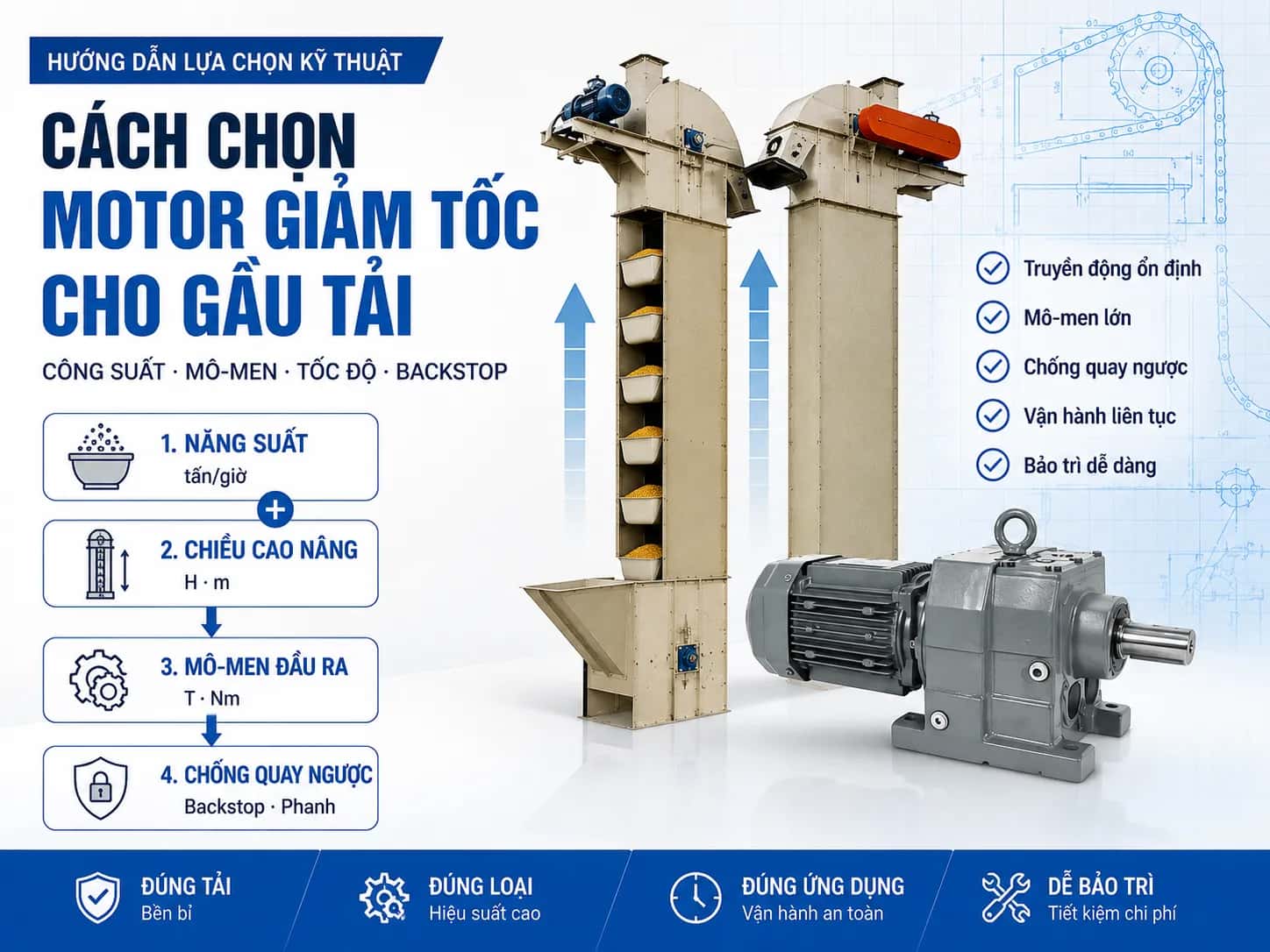
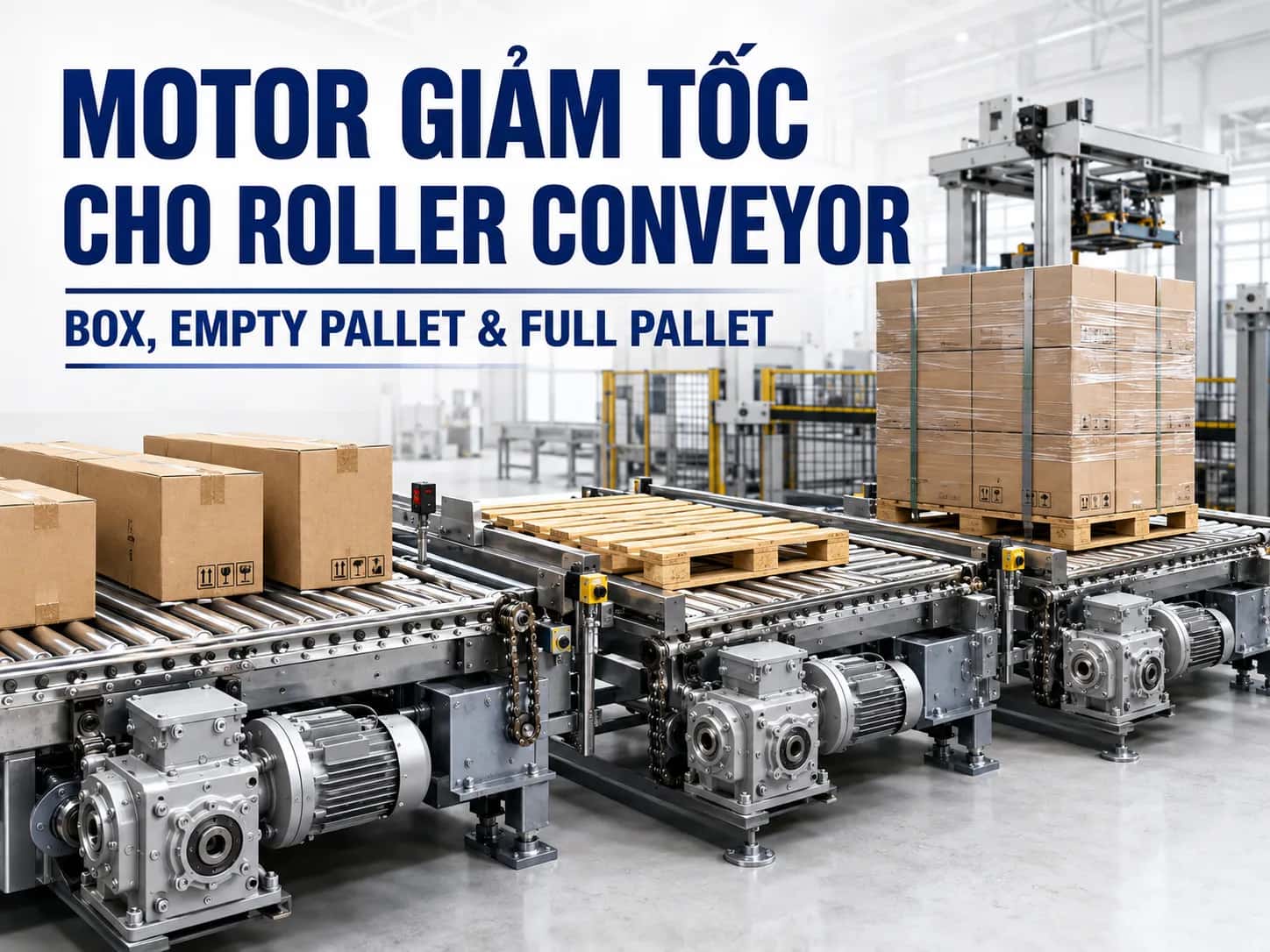
Gearboxes are widely used in conveyors, mixers, crushers, screw conveyors, and production lines.
Application in Conveyors
Conveyors are one of the most common applications for gearboxes. The device helps reduce the motor's rotational speed and increase pulling force to transport goods, raw materials, packaging, coal, cement, agricultural products, or production components.
Application in Mixers and Agitators
Mixers and agitators require high torque to rotate the blades in high-viscosity environments. Gearboxes help the equipment operate stably, avoid motor overload, and reduce mechanical shock.
Application in Crushers and Presses
Crushers, presses, and rolling mills often require very high force at low speeds. Gearboxes help increase output torque, suitable for heavy-duty and continuous-working applications.
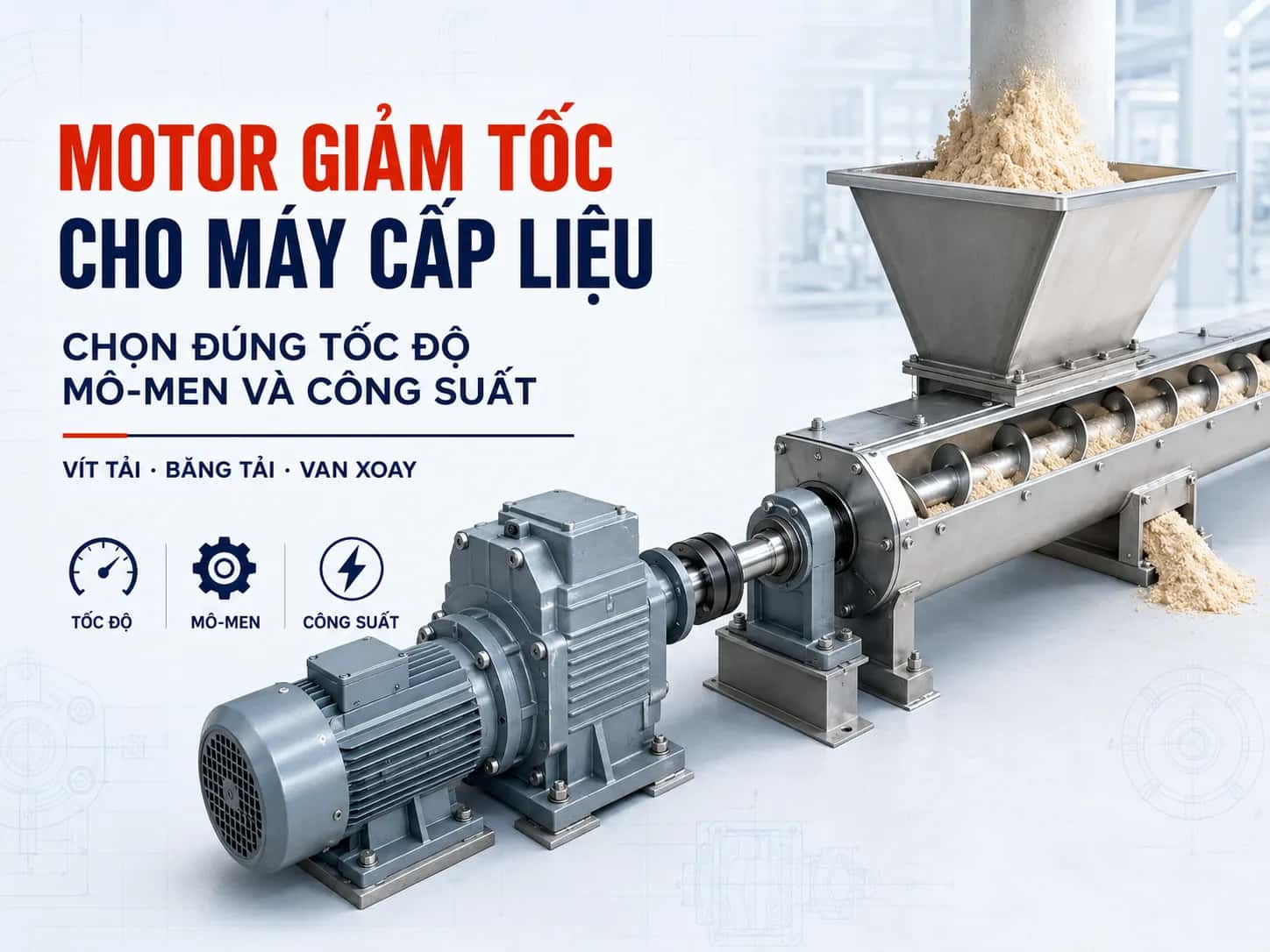
Application in Screw Conveyors
Screw conveyors require low speed, stable pulling force, and continuous operation capability. Gearboxes are often combined with electric motors to form a transmission unit for screw conveyors in cement, food, plastic, chemical, and agricultural industries.
Application in Cranes and Lifting Equipment
In lifting systems, gearboxes help generate high torque to lift loads safely. For this application, it is often necessary to combine with magnetic brakes, VFDs, or protective devices to ensure operational safety.
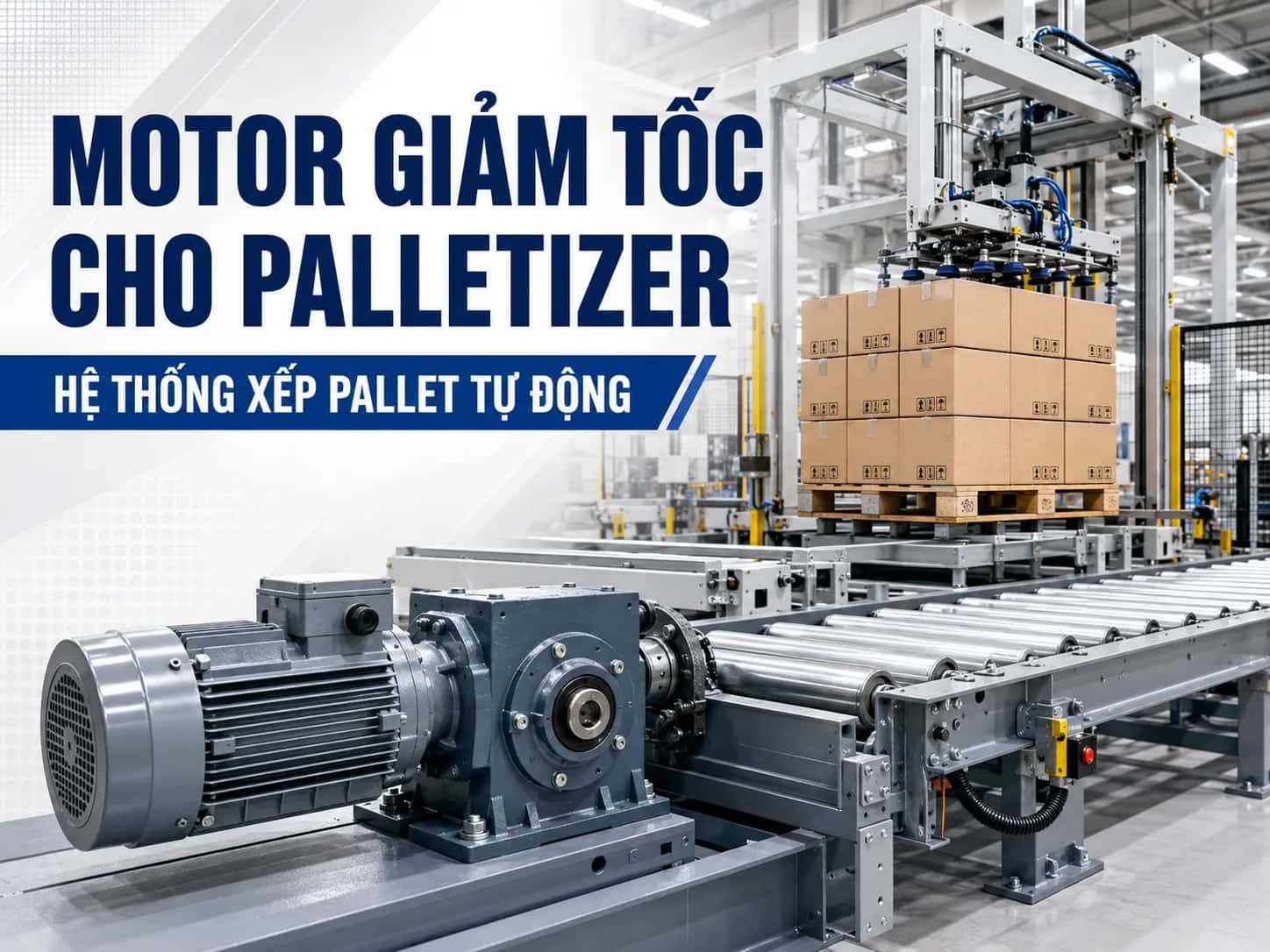
Application in Automation Lines
Gearboxes are used in packaging machines, filling machines, sorting machines, robots, rotary mechanisms, and automation systems requiring precise transmission.
How to Select the Right Gearbox
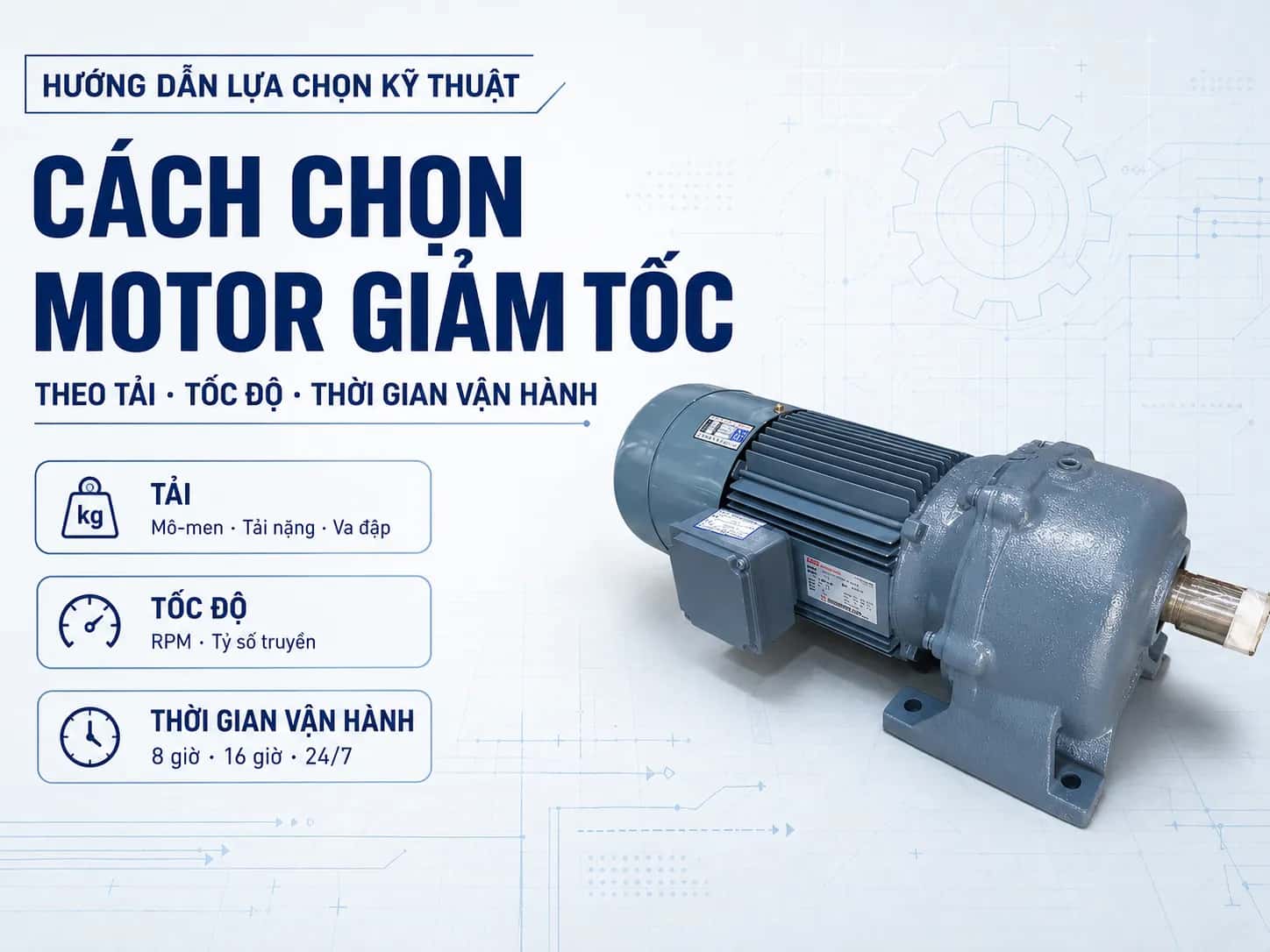
To select the correct gearbox, do not rely solely on motor power. It is necessary to consider speed, torque, load characteristics, working environment, and mounting style.
Determine Motor Power
Motor power is an important input parameter. The gearbox must match the motor power to avoid overload, gear breakage, oil overheating, or bearing damage.
Determine Desired Output Speed
It is necessary to know the required output speed of the machine to select the appropriate gear ratio. If the speed is too high, the machine may operate unstably. If the speed is too low, productivity may decrease.
Calculate Torque
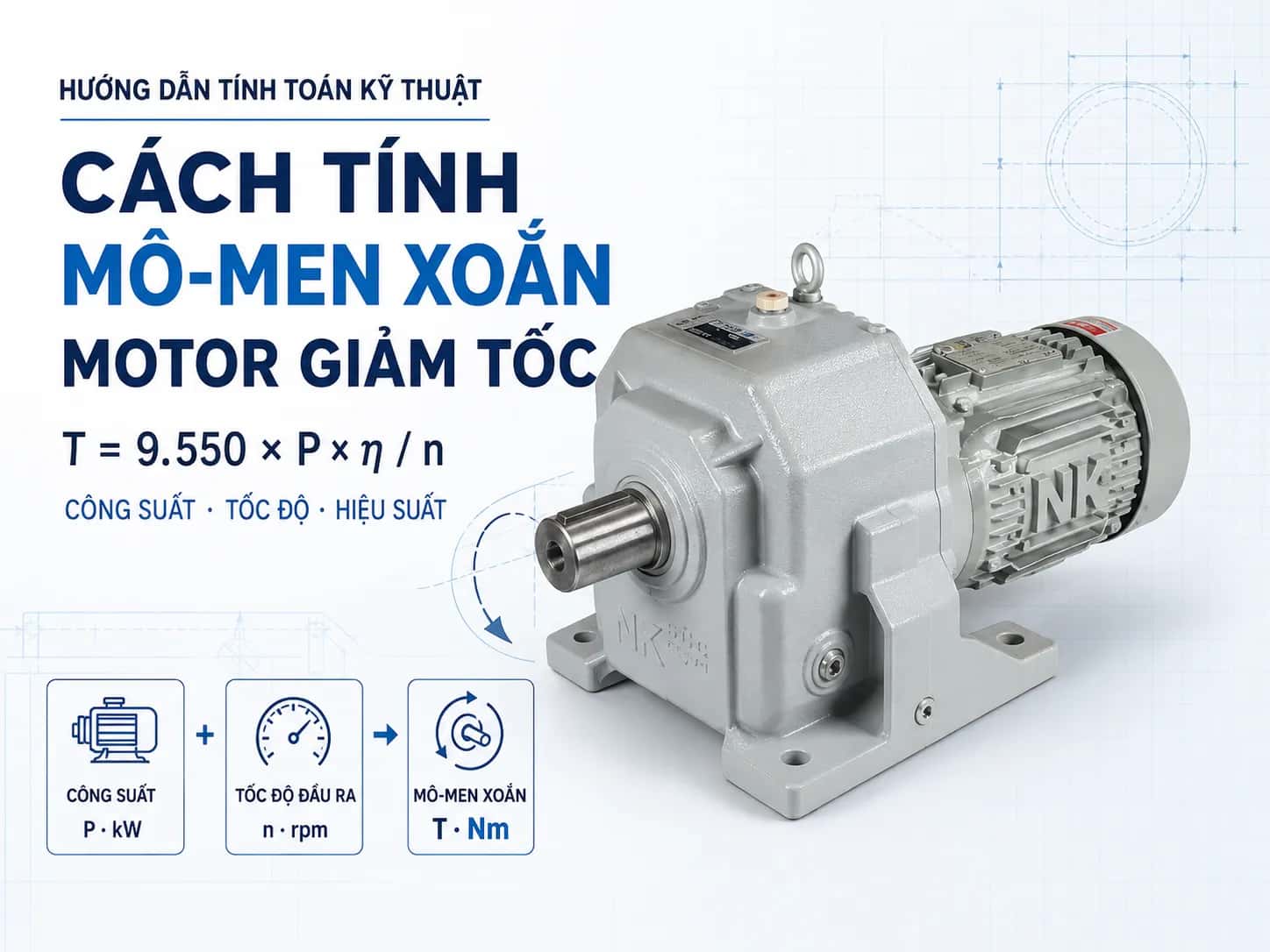
Torque is the most important factor for heavy loads. Reference formula:
T = 9550 × P / n
Where:
Symbol | Meaning | Unit |
|---|---|---|
T | Torque | N.m |
P | Motor power | kW |
n | Output rotational speed | rpm |
Determine Load Characteristics
Load Type | Example | Selection Suggestion |
|---|---|---|
Light load | Light conveyor, packaging machine | Choose standard gearbox |
Medium load | Mixer, cargo conveyor | Choose higher safety factor |
Heavy load | Crusher, screw conveyor, press | Choose heavy-duty gearbox |
Shock load | Stone crusher, material press | Prioritize Cycloid or shock-resistant series |
Select Mounting Style
Common mounting styles include:
Foot-mounted.
Flange-mounted.
Hollow shaft.
Solid shaft.
Right-angle shaft.
Coaxial shaft.
Vertical or horizontal mounting.
It is necessary to check the dimension drawing before purchasing to ensure it fits the existing machine.
Check Working Environment
If the gearbox operates in dusty, wet, chemical, outdoor, or high-temperature environments, it is necessary to select the appropriate protection class, oil seals, housing material, and lubricating oil.
Proper Gearbox Maintenance
Proper maintenance helps the gearbox operate durably, reduces damage, and extends the device's lifespan.
Check Lubricating Oil
Lubricating oil needs to be checked periodically for oil level, contamination, color, and viscosity. If the oil is black, has a burnt smell, or contains metal shavings, it is necessary to change the oil and check inside the gearbox.
Check Noise and Vibration
Abnormal noise can come from worn gears, damaged bearings, lack of oil, or misalignment. It is necessary to check early to avoid severe damage.
Check Oil Seals
If oil leakage is observed at the input shaft, output shaft, or housing joints, it is necessary to check the oil seals, gaskets, and internal pressure of the gearbox.
Align Concentricity
Misalignment between the motor, gearbox, and load can cause heavy vibration, bearing wear, and shaft breakage. When installing, it is recommended to align using appropriate tools.
Do Not Operate Overload
Operating under overload for a long time increases oil temperature, wears out gears, and reduces the gearbox's lifespan. It is necessary to check the motor current and actual torque if the system is frequently overloaded.
Common Gearbox Faults
Overheating Gearbox
Causes may include lack of oil, incorrect oil viscosity, overload, damaged bearings, or an excessively hot environment.
The solution is to check the oil level, change to the correct type of oil, reduce the load, and check the bearings if the temperature rises abnormally.
Loud Gearbox Noise
Loud noise is usually caused by worn gears, damaged bearings, misalignment, or lack of lubricating oil.
It is necessary to stop the machine and check early to avoid gear breakage or shaft damage.
Oil Leakage
Oil leakage is usually caused by worn seals, incorrect installation, high internal pressure, or damaged flange gaskets.
It is necessary to replace with the correct size seal, check the breather, and tighten the assembly points.
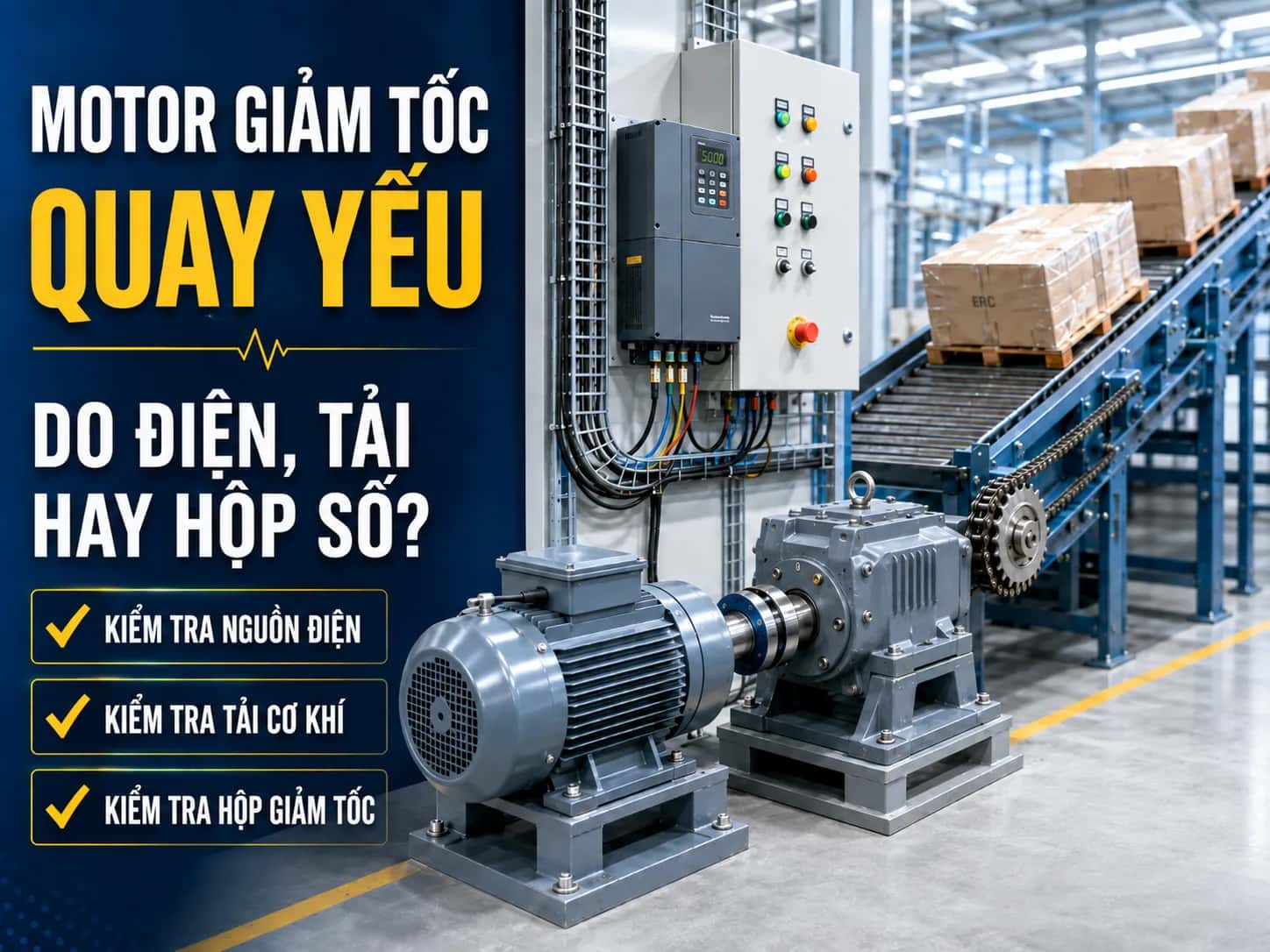
Weak or Non-Rotating Output Shaft
Causes may include broken gears, stripped keys, damaged couplings, or heavy overload. This is a serious fault requiring a full mechanical check of the entire transmission assembly.
What Factors Affect Gearbox Price?
Gearbox prices are not fixed because they depend on many technical and commercial factors.
Factor | Impact on Price |
Motor power | Higher power, larger gearbox |
Gear ratio | Special gear ratios may cost more |
Gearbox type | Planetary, Cycloid, worm, gear have different prices |
Housing material | Cast iron housing is usually higher than aluminum |
Precision | Low-backlash series have higher prices |
Brand | European, Japanese, Korean, Taiwanese, Chinese have different segments |
Mounting style | Flange, hollow shaft, solid shaft, special shaft affect price |
Working environment | Outdoor, corrosion-resistant, heavy-duty require special options |
When requesting a quote, it is recommended to provide full details on motor power, output speed, gear ratio, mounting style, shaft diameter, load application, and operating environment.
Where to Buy a Reliable Gearbox?
A gearbox is a device that directly affects the stability of a production line. Therefore, businesses should choose a supplier with technical capability, genuine products, and the ability to provide correct application advice.
MDRIVE TECH provides industrial transmission and automation solutions, including gearboxes, geared motors, electric motors, VFDs, soft starters, and related industrial electrical equipment.
MDRIVE TECH supports:
Consulting on selecting gearboxes based on actual load.
Calculating gear ratios, output speeds, and torque.
Providing gearboxes for conveyors, mixers, crushers, screw conveyors, and production lines.
Providing catalogs, technical drawings, CO, CQ upon request.
Consulting on combining gearboxes with motors, VFDs, and control systems.
Contact MDRIVETECH now for technical advice, product catalogs, and quotes.
Hotline: 0868 789 647
Email: [email protected]
FAQ – Frequently Asked Questions About Gearboxes
What is a gearbox?
A gearbox is a mechanical transmission device used to reduce rotational speed from an electric motor and increase output torque to suit industrial loads.
What is the function of a gearbox?
A gearbox helps reduce speed, increase pulling force, protect the motor, stabilize the transmission system, and help machines operate at the required speed.
What is a gearbox gear ratio?
The gear ratio indicates how many times the input speed is reduced compared to the output speed. For example, a 1:50 gear ratio means the output speed is equal to the input speed divided by 50.
What is the difference between a gearbox and a geared motor?
A gearbox is a separate mechanical speed reduction part. A geared motor is an integrated unit between an electric motor and a gearbox, usually assembled synchronously as a complete transmission set.
When should a worm gearbox be used?
A worm gearbox is suitable for applications requiring high gear ratios, compact size, right-angle transmission, and not-too-heavy continuous loads.
When should a Cycloidal gearbox be used?
A Cycloidal gearbox is suitable for heavy loads, shock loads, industrial conveyors, mixers, crushers, and applications requiring high mechanical durability.
What information is needed to select a gearbox?
It is necessary to provide motor power, motor speed, desired output speed, gear ratio, mounting style, shaft diameter, load type, operating time, and operating environment.