What Are Motor Insulation Classes F and H?
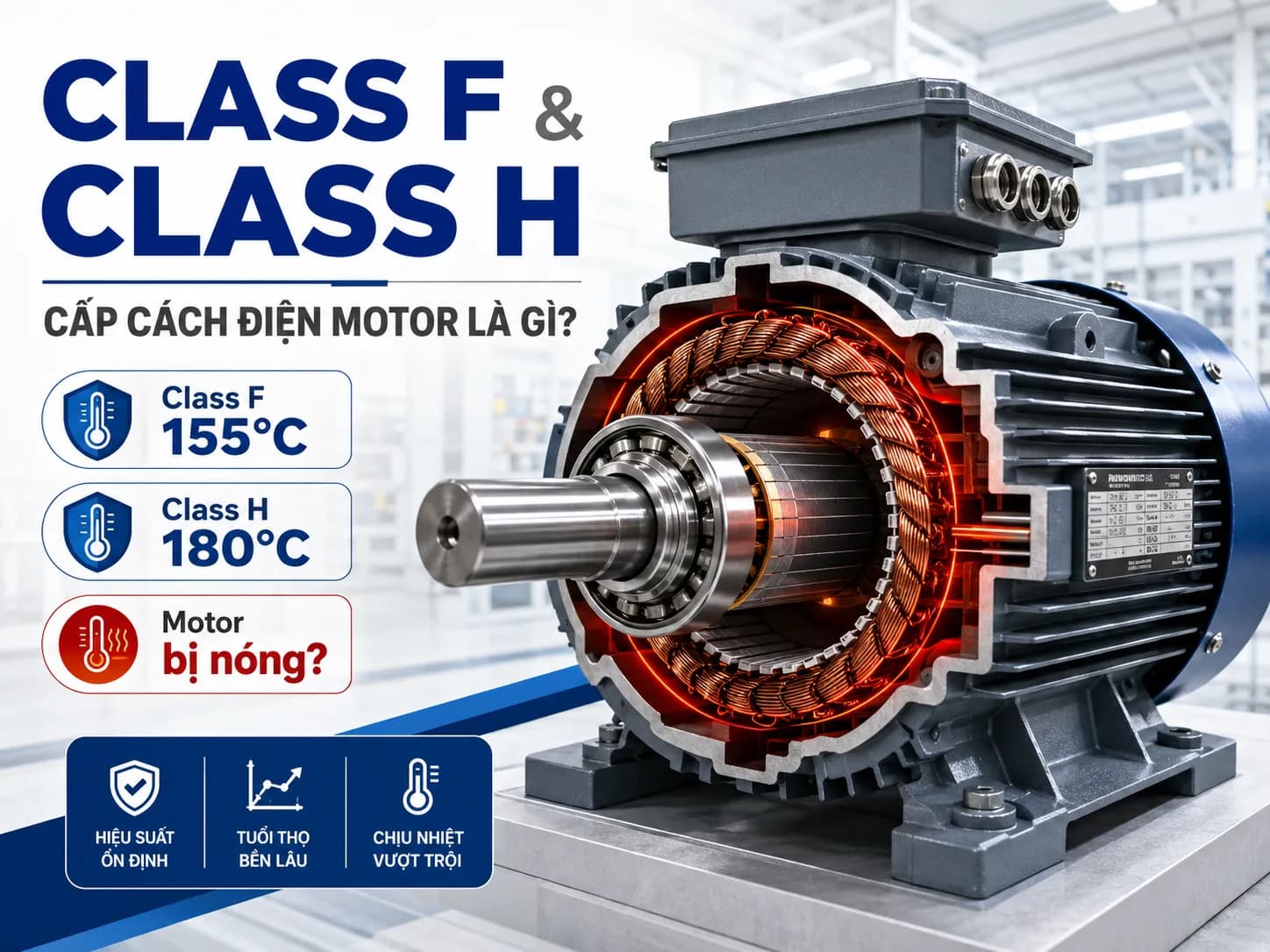
Class F and Class H represent the thermal resistance ratings of motor insulation systems. Class F is rated for a maximum temperature of 155°C, while Class H is rated for 180°C. Higher insulation classes offer better heat resistance, though proper selection based on load, environment, and operating conditions remains essential.
What Are Class F and Class H Insulation Classes for Motors? Differences and Selection Guide
Class F and Class H are thermal rating classes for motor insulation systems. Class F has a maximum temperature rating of 155°C, while Class H is rated for up to 180°C. A higher insulation class allows the motor to withstand higher temperatures, but it is still essential to ensure proper load selection, adequate cooling, and operation within specified conditions.
What is motor insulation class?
Motor insulation class is a parameter indicating the thermal withstand capability of the insulation system inside an electric motor, particularly the insulation around the stator windings. When a motor operates, the current flowing through the windings generates heat. If the winding temperature exceeds the permissible limit for an extended period, the insulation layer may degrade, crack, suffer from reduced insulation resistance, and lead to turn-to-turn shorts, phase-to-phase shorts, or motor burnout.
Therefore, the insulation class is more than just a symbol on the motor nameplate. It is a parameter directly related to the service life, safety, and stable operational capability of the motor in an industrial environment.
Common insulation classes include:
Insulation Class | Reference Temperature Limit |
|---|---|
Class A | 105°C |
Class E | 120°C |
Class B | 130°C |
Class F | 155°C |
Class H | 180°C |
In modern industrial motors, Class F and Class H are the two most frequently mentioned classes, especially for 3-phase motors, high-efficiency motors, gear motors, VFD-driven motors, explosion-proof motors, and motors operating under heavy-duty conditions.
What is Class F for motors?
Class F is an insulation class with a maximum temperature limit of 155°C for the insulation system. This is a very common insulation class in modern industrial motors.
In simple terms, Class F motors use insulation materials capable of withstanding higher temperatures than lower classes such as Class B. This provides the motor with a better thermal safety margin when operating in industrial environments, especially during load fluctuations, power supply variations, or continuous long-term operation.
Class F is commonly used for:
Industrial 3-phase electric motors
IE2, IE3, IE4 motors
Pump motors
Fan motors
Conveyor motors
Geared motors
Agitator motors
Packaging machine motors
Motors used with VFDs in standard applications
Motors operating continuously in factories
However, Class F does not mean the motor should run continuously at 155°C. This is the thermal limit of the insulation system, not the ideal operating temperature. If a motor frequently runs near this limit, the insulation lifespan will still decrease rapidly.
What is Class H for motors?
Class H is an insulation class with a maximum thermal limit for the insulation system of 180°C. Compared to Class F, Class H has higher heat resistance and is typically used for motors operating in more demanding conditions.
Class H is commonly found in:
Heavy-duty motors
Motors operating in high-temperature environments
Motors used with VFDs running at low speeds for extended periods
Explosion-proof motors
Specialized industrial motors
Motors in areas with poor ventilation
Motors requiring a higher thermal margin
Certain high-efficiency or specialized motors
Class H has better heat resistance than Class F, but it does not mean that Class H is always better in every case. If the application only involves standard loads such as pumps, fans, conveyors, or packaging machines, Class F is sufficient for many scenarios.
Comparison between Class F and Class H
Criteria | Class F | Class H |
|---|---|---|
Insulation system temperature limit | 155°C | 180°C |
Heat resistance | High | Very high |
Popularity | Very common in industrial motors | Widely used for heavy-duty or hot environments |
Cost | Generally more economical | Generally higher |
Suitable applications | Pumps, fans, conveyors, geared motors, industrial machines | Heavy-duty, hot environments, specialized motors, heavy VFD applications |
Is it necessary for every motor? | Suitable for most applications | Not necessary for every application |
Simply put:
Class F is suitable for most standard industrial motors. Class H is more appropriate when the motor needs to withstand higher temperatures, perform heavier duties, or operate in more demanding environments.
What do the 155°C and 180°C temperatures refer to?
This is a point that many people misunderstand.
The 155°C for Class F and 180°C for Class H temperatures are the limiting temperatures of the insulation system inside the motor, relating to the windings and the hottest spot within the motor. These are not the motor housing temperatures measured externally by hand or with a thermal gun.
The motor housing temperature is typically lower than the internal winding temperature. Therefore, when measuring 70°C or 80°C on the motor housing, one cannot immediately conclude that the windings are at the same level. To accurately assess the winding temperature, specialized measurement methods, thermal sensors, or calculations based on winding resistance are required.
However, if the motor shows signs such as abnormal overheating, a burning smell, high current, strange noises, or strong vibrations, it must be checked immediately, regardless of whether the insulation class is Class F or Class H.
What is the motor's temperature rise?
Temperature rise is the increase in the motor's temperature relative to the ambient temperature. This is a very important parameter when evaluating whether a motor is operating within safe limits.
A simple example:
If the ambient temperature is 40°C and the motor increases by 80°C under load, the internal operating temperature can be assessed based on this temperature rise plus other technical margins depending on the design standard.
When viewing a motor catalog or nameplate, you may encounter terms such as:
Temperature rise Class B
Temperature rise Class F
Insulation Class F
Insulation Class H
Ambient 40°C
Duty S1
It is necessary to clearly distinguish between:
Insulation Class: the thermal resistance class of the insulation material
Temperature Rise: the temperature increase during motor operation
Ambient Temperature: the temperature of the surrounding environment
Duty: the motor's operating mode
A good motor not only has a high insulation class but also exhibits a low temperature rise during actual operation.
What is Class F/B?
In practice, some motors are labeled as Class F insulation, Class B temperature rise, often abbreviated as F/B.
Interpretation:
The motor uses a Class F insulation system
But the temperature rise during operation only follows the Class B level
The remaining difference serves as a thermal safety margin
This is a good design because the motor has insulation material capable of withstanding 155°C but operates cooler. When a motor runs cooler than its permitted limit, the insulation life is typically better, and the motor is more capable of handling abnormal situations such as slight overloads, high ambient temperatures, or power supply fluctuations.
A simple example:
A Class F motor with a temperature rise limited to Class B provides a better thermal safety margin compared to a Class F motor operating consistently near its Class F limit.
What is Class H/F?
Similarly, some motors may be labeled Class H insulation, Class F temperature rise, commonly referred to as H/F.
Interpretation:
The motor utilizes a Class H insulation system
However, the design temperature rise is limited to Class F
The motor possesses an additional thermal safety margin compared to operating at the Class H limit
The H/F design is typically suitable for applications with higher requirements for service life, thermal durability, or more demanding operating environments.
However, when reading this specification, it is important to note: Class H/F does not mean the motor will never get hot. If the motor is overloaded, has poor ventilation, faulty bearings, operates at incorrect voltage, or uses a VFD improperly, it can still overheat.
Why do Class F motors still get hot?
Class F motors can still overheat because the insulation class only indicates the thermal resistance capability of the insulation materials, not the ability to resist all causes of heat.
A Class F motor may overheat due to:
Mechanical overload
Low voltage
Phase imbalance
Current exceeding the rated value
Dry or damaged bearings
Broken, dirty, or incorrectly installed cooling fan
Cooling fins covered by dust
Motor installed in an enclosed space with poor ventilation
Excessively high ambient temperature
Motor operated at low speeds for too long using a VFD
Over-tensioned conveyor belts, jammed machinery, or faulty gearboxes
Selecting a motor that is too small for the actual load
Therefore, when a motor gets hot, one should not simply ask, "What is the temperature limit for Class F?". It is necessary to inspect the entire system, including the load, current, power supply, cooling, bearings, gearbox, and operating conditions.
Is Class H better than Class F?
Class H has a higher thermal resistance than Class F, but it is not always the more economical choice.
Under the same operating conditions, Class H provides a higher thermal tolerance margin. This is advantageous for motors operating in hot environments, heavy-duty loads, or where a larger thermal reserve is required. However, for standard applications such as conveyors, pumps, fans, packaging machines, or steady-load gear motors, Class F is usually sufficient.
In other words:
Class H is superior in thermal resistance
Class F is generally more economical and sufficient for most applications
The most important factor remains selecting the correct load and controlling heat during operation
One should not choose Class H simply under the assumption that "higher is always better." If the motor is incorrectly sized, overloaded, or poorly cooled, even a Class H motor can overheat and fail.
Should Class F or Class H be chosen for VFD-driven motors?
Motors driven by VFDs typically face more complex operating conditions than those running on direct-on-line power. When using a VFD, the motor may operate at low speeds, with varying frequencies, fluctuating currents, and exposure to voltage pulses from the inverter.
For standard VFD applications, Class F is generally sufficient if:
The motor is correctly sized
The load is not excessive
The motor does not run at low speeds for extended periods
Cooling remains adequate
Motor cables are not excessively long
The VFD is properly configured
The motor is suitable for VFD operation
Consider Class H or inverter-duty motors when:
The motor runs at low speeds for long durations
The load is heavy or requires high starting torque
The motor runs continuously near its rated capacity
The ambient temperature is high
Motor cables are long
The application requires high durability
The motor is difficult to take offline for maintenance
The system has a high risk of overheating
For VFD-driven motors, insulation class is only one factor. It is necessary to also verify voltage spike resistance, forced cooling, bearing protection, and actual installation conditions.
Should explosion-proof motors use Class F or Class H?
Explosion-proof motors typically have stricter requirements regarding surface temperature, ingress protection, gas/dust groups, hazardous zones, and explosion-proof standards. Therefore, one cannot determine if a motor is suitable based solely on Class F or Class H ratings.
When selecting an explosion-proof motor, it is necessary to check:
Explosion-proof standards
Operating area: Zone 1, Zone 2, Zone 21, Zone 22
Gas group or dust group
Temperature class such as T3, T4, T5
IP protection rating
Ambient temperature
Operating load
Whether a VFD is used
Motor certification
Class H can help improve the thermal endurance of the insulation system, but for explosion-proof motors, it is more important that the motor complies with the correct standards and holds the appropriate explosion-proof certifications for the intended environment.
How does insulation class relate to motor lifespan?
It does. Insulation class is directly related to motor lifespan because the winding insulation degrades faster when operating at high temperatures.
When insulation degrades, the motor may experience the following faults:
Reduced insulation resistance
Current leakage
Turn-to-turn short circuit
Phase-to-phase short circuit
Phase-to-ground short circuit
Abnormal motor heating
Winding burnout
Production line downtime
A motor with a higher insulation class will have better thermal resistance. However, actual lifespan still depends on operation. A Class F motor running cool, at the correct load, and with good ventilation may be more durable than a Class H motor that is frequently overloaded and runs hot.
How to read Class F and Class H on a motor nameplate
On a motor nameplate, the insulation class may be indicated in various formats:
INS. CLASS F
Insulation Class F
Ins. F
Class F
INS. CLASS H
Insulation Class H
Ins. H
Class H
When reading a nameplate, do not look at the insulation class alone. It is necessary to simultaneously check the following parameters:
Motor power
Voltage
Rated current
Frequency
Speed (rpm)
Insulation class
IP protection rating
Permissible ambient temperature
Duty cycle
Service factor
IE efficiency
VFD compatibility
For example, while both are Class F motors, a motor with S1 duty, IP55, IE3, inverter duty, and low temperature rise will differ significantly from a standard motor without sufficient thermal margin.
Signs of motor overheating
Regardless of whether it is Class F or Class H, a motor should be inspected when there are signs of abnormal heating.
Common signs include:
Motor housing is hotter than usual
Burning smell
Current higher than rated value
Reduced motor torque
Excessive motor vibration
Loud motor noise
VFD reports overload or overheating
Thermal relay, MCCB, or MCB trips frequently
Discoloration of motor housing paint
Hot terminal box
Noisy or overheating bearings
Cooling fan not rotating or rotating weakly
When these signs occur, it is recommended to measure the current per phase, check the power supply, inspect the mechanical load, examine the bearings and cooling fan, and verify the ventilation conditions around the motor.
How to inspect an overheating motor in a factory
When a motor overheats, it can be inspected following this sequence:
Check the actual current against the rated current on the nameplate
Check the voltage of each phase
Check for phase imbalance
Check if the mechanical load is jammed
Inspect the bearings
Inspect the cooling fan
Clean the cooling fins
Check the ambient temperature
Check if the motor is obstructed or covered
If using a VFD, check the frequency, current, carrier frequency, and acceleration/deceleration times
Check the gearbox, pulleys, chains, couplings, or conveyors
Measure insulation resistance if insulation degradation is suspected
Do not simply replace the motor without identifying the cause of overheating. If the cause originates from the load or the mechanical system, the new motor may also overheat and fail again.
How to select motor insulation class by application
Application | Recommended insulation class |
|---|---|
Standard conveyor | Class F |
Pump | Class F |
Industrial fan | Class F |
Geared motor | Class F or Class H depending on load |
Packaging machine | Class F |
Feeder machine | Class F |
Light/medium duty agitator | Class F |
Heavy duty agitator | Class F with good margin or Class H |
VFD-driven motor at low speed | Class F inverter duty or Class H |
High-temperature environment | Class H |
Explosion-proof motor | According to explosion-proof standards and manufacturer design |
Heavy load, continuous operation | High-quality Class F or Class H |
Critical application with low downtime tolerance | Prioritize higher insulation class and check temperature rise |
This table serves as an initial guideline only. Actual selection must be based on the motor catalogue, working load, environment, duty cycle, starting method, and plant operational requirements.
Common misconceptions about Class F and Class H
1. Thinking Class H is always better in every case
Class H withstands higher temperatures, but if the application does not require that level of heat resistance, Class F may be a more economical and reasonable choice.
2. Thinking Class F motors are allowed to run continuously at 155°C
155°C is the limit of the insulation system, not the ideal operating temperature. Running closer to the thermal limit reduces the lifespan of the insulation.
3. Confusing motor housing temperature with winding temperature
The housing temperature is not equal to the winding temperature. The motor housing is typically cooler than the internal temperature.
4. Concluding that a hot motor means a low insulation class
A hot motor can be caused by overloading, poor power supply, damaged bearings, weak cooling fans, dirt, poor ventilation, or improper VFD usage.
5. Not reading the temperature rise
Insulation Class and Temperature Rise are two different pieces of information. A Class F motor with a low temperature rise may have better thermal durability in actual operation.
FAQ – Frequently Asked Questions
What is a Class F motor?
A Class F motor is a motor with an insulation system capable of withstanding a maximum temperature of 155°C. This is the common insulation class for industrial motors today.
What is a Class H motor?
A Class H motor is a motor with an insulation system capable of withstanding a maximum temperature of 180°C. Class H is typically used for high-temperature environments, heavy-duty loads, or specialized motors.
How do Class F and Class H differ?
Class F withstands a maximum temperature of 155°C, while Class H withstands up to 180°C. Class H offers higher heat resistance, but Class F is sufficient for many standard industrial applications.
Can a Class F motor withstand 155°C continuously?
Class F has an insulation system temperature limit of 155°C, but the motor should not be operated continuously near this level. If the motor frequently runs near its thermal limit, the insulation lifespan will decrease rapidly.
Is Class H better than Class F?
Class H withstands higher temperatures than Class F, but not every application requires Class H. For conveyors, pumps, fans, and standard industrial machinery, Class F is usually sufficient.
Is a hot motor caused by a low insulation class?
Not necessarily. A hot motor can be caused by overloading, low voltage, phase imbalance, damaged bearings, weak cooling fans, dirt, installation in confined spaces, or improper VFD usage.
What is a normal motor housing temperature?
There is no universal figure for all motors. The housing temperature depends on the design, load, environment, and measurement method. If the motor is abnormally hot, emits a burning smell, draws high current, or vibrates excessively, it should be checked immediately.
Should I choose Class F or Class H for VFD-driven motors?
For standard VFD applications, Class F may suffice if the motor is correctly sized for the load and well-cooled. If running at low speeds for extended periods, under heavy loads, or in hot environments, Class H or an inverter-duty motor should be considered.
What does Class F/B mean?
Class F/B means the motor uses a Class F insulation system but the temperature rise is designed according to Class B. This design provides better thermal margin.
What does Class H/F mean?
Class H/F means the motor uses a Class H insulation system but the temperature rise is designed according to Class F. This design creates additional thermal margin for the motor.
Conclusion
Class F and Class H are two important insulation classes for industrial electric motors. Class F has a temperature limit of 155°C, suitable for most applications such as conveyors, pumps, fans, gear motors, and general industrial machinery. Class H has a temperature limit of 180°C, which is more suitable for heavy loads, hot environments, motors used with low-speed VFDs, or applications requiring high thermal margin.
However, the insulation class is not the only factor determining motor durability. A durable motor must be selected with the correct power rating, load, IP protection class, duty cycle, proper cooling, and verification of actual operating current.
If a motor overheats, one should not look only at Class F or Class H. It is necessary to check the entire system including the power supply, mechanical load, bearings, cooling fan, VFD, gearbox, and operating environment.
MDriveTech provides consultation for selecting electric motors, gear motors, VFDs, and industrial drive solutions based on power rating, operating load, working environment, and actual technical requirements.
Hotline: 0868 789 647
Email: [email protected]