What is Gearbox Service Factor? How to Select Correctly
The gearbox service factor is a selection coefficient based on load, operating time, and start frequency. Learn how to calculate and select the right gearbox.
What Is a Gearbox Service Factor? How to Select Correctly
What is a gearbox Service Factor?
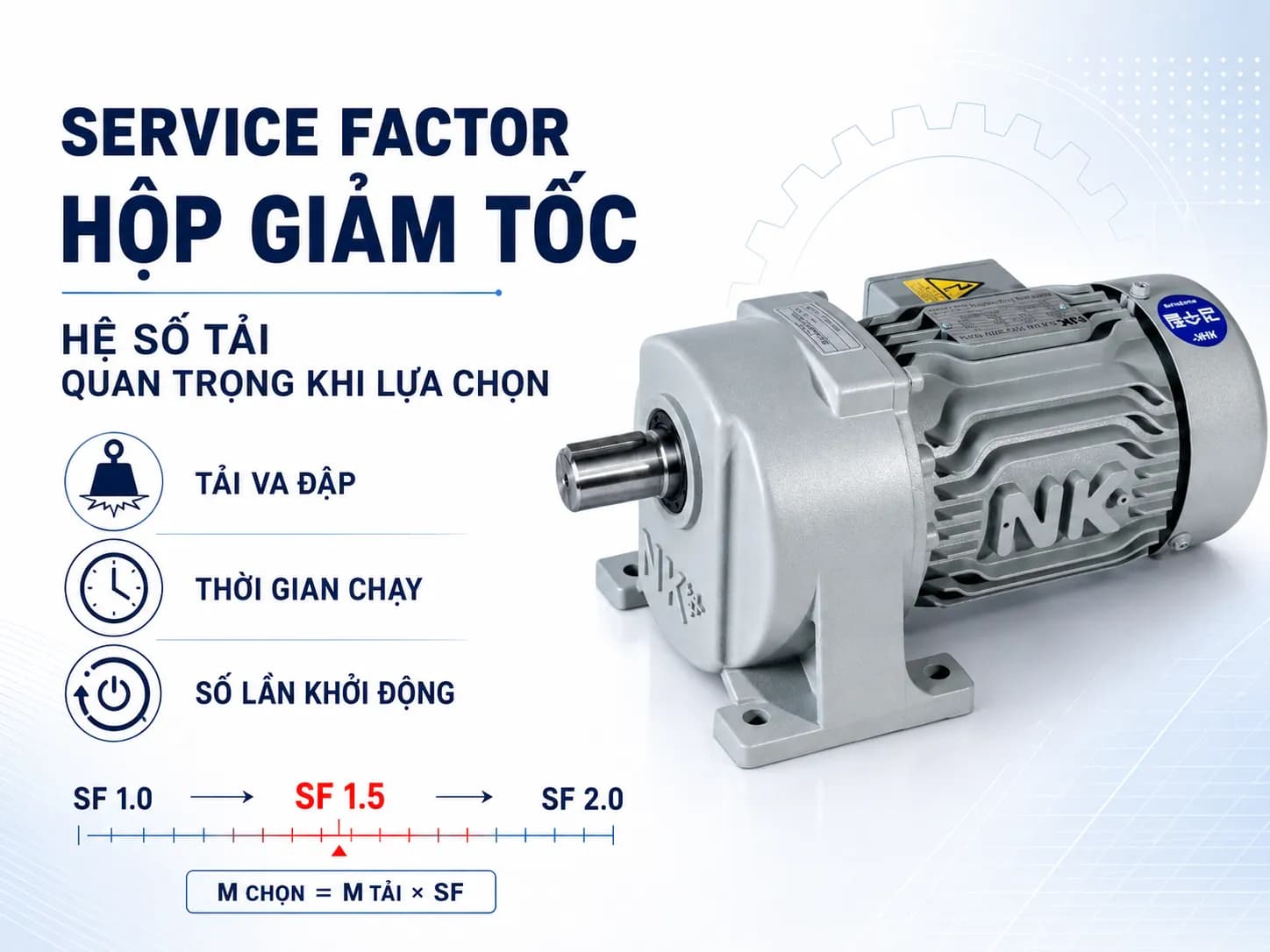
Service Factor, often abbreviated as SF, is a coefficient used to select a gearbox based on actual operating conditions.
This parameter reflects:
Uniform or shock load characteristics.
Daily operating hours.
Number of starts and stops.
Loaded or no-load starting.
Reversing frequency.
Peak load torque.
Simply put, the Service Factor represents the required load safety margin of the gearbox.
If you select a gearbox based solely on motor power without checking the Service Factor, the unit may overheat, experience gear wear, suffer bearing failure, or have a reduced service life when operating under heavy loads.
Service Factor calculation formula
The torque used to select a gearbox can be calculated using the following formula:
Mtk = Mt × SF
Where:
Mtk: Calculated torque for gearbox selection.
Mt: Actual load torque.
SF: Required Service Factor.
The selected gearbox must have a rated torque greater than or equal to the calculated torque.
Example
A conveyor requires an actual torque of 400 Nm, with a required Service Factor of 1.5:
Mtk = 400 × 1.5 = 600 Nm
The gearbox must have a rated torque of 600 Nm or higher at the required output speed.
What do Service Factors 1.0, 1.5, and 2.0 mean?
Service Factor | Safety Margin |
|---|---|
1.0 | Equivalent to required load |
1.25 | Approximately 25% margin |
1.5 | Approximately 50% margin |
2.0 | Approximately twice the required load |
For an actual load of 500 Nm:
SF 1.0: Select from 500 Nm.
SF 1.25: Select from 625 Nm.
SF 1.5: Select from 750 Nm.
SF 2.0: Select from 1,000 Nm.
However, an SF of 1.5 does not mean the gearbox is allowed to be continuously overloaded by 50%. Operational capability also depends on peak load, speed, temperature, mounting orientation, and lubrication conditions.
Factors affecting the Service Factor
1. Load characteristics
Uniform load
Minimal load fluctuations, low shock.
Example:
Light-duty conveyors.
Roller conveyors.
Fans.
Light-duty packaging machines.
Uniform rotating mechanisms.
Variable loads
Loads that increase or decrease during operation.
Examples:
Screw conveyors.
Feeders.
Agitators.
Mixers.
Non-uniform feed conveyors.
Shock loads
Loads that increase rapidly or encounter high resistance for short periods.
Examples:
Crushers.
Shredders.
Presses.
Rolling mills.
Continuous reversing mechanisms.
The heavier the load and the greater the shock, the higher the required Service Factor usually is.
2. Operating time
Gearboxes running 16–24 hours per day require a higher safety margin than equipment operating for only a few hours.
Longer running times increase:
Oil temperature.
Bearing temperature.
Gear load duration.
Lubrication and heat dissipation requirements.
For systems running continuously, both the mechanical load capacity and the thermal capacity of the gearbox must be checked.
3. Number of starts
At each start, the gearbox must accelerate the motor, the transmission mechanism, and the entire load.
It is necessary to determine:
Number of starts per hour.
Whether starting under load or not.
Acceleration time.
Whether frequent reversing occurs.
Whether emergency stops occur.
Machines that start frequently or reverse continuously often require a higher Service Factor.
4. Starting torque and peak loads
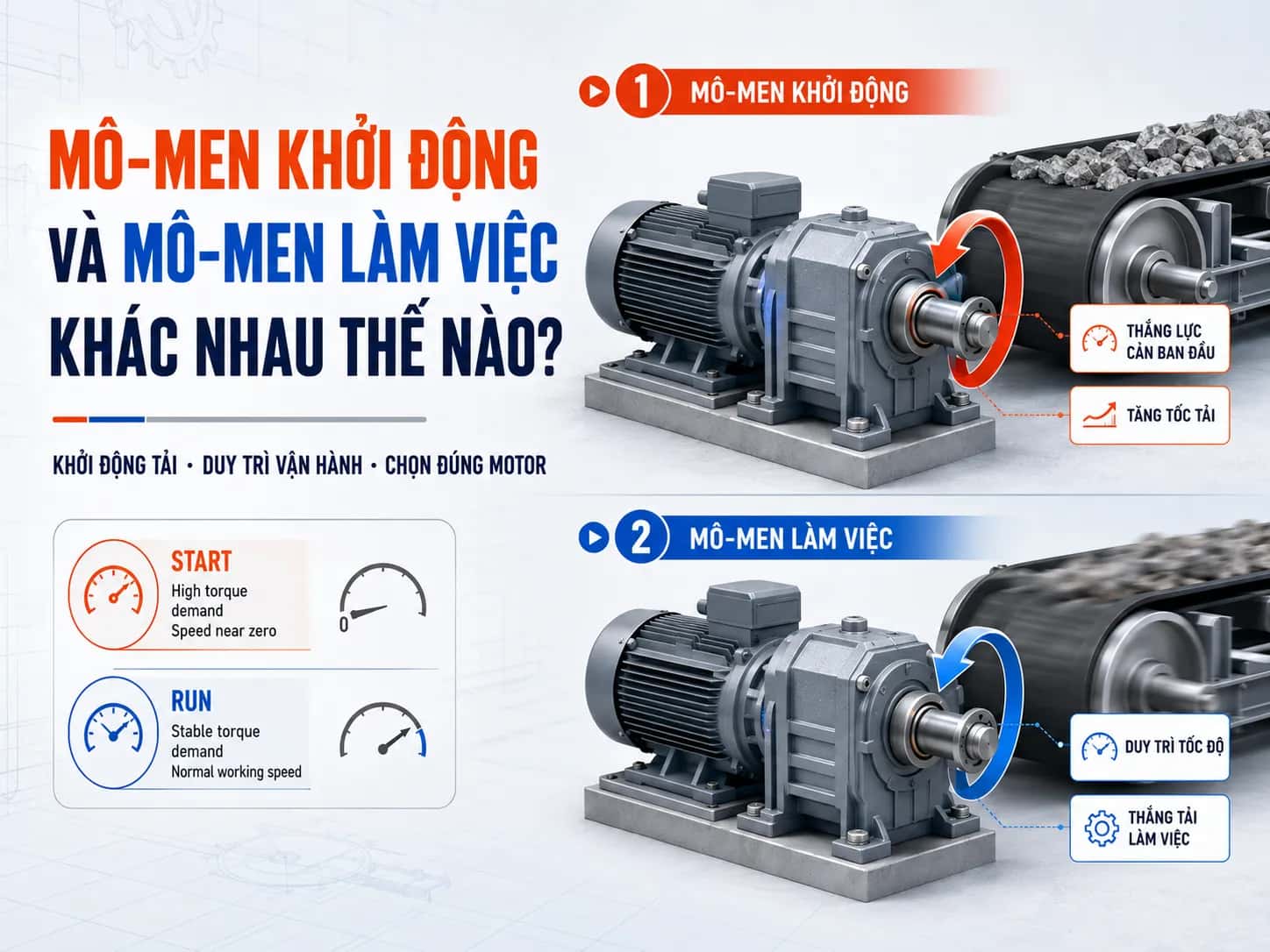
The Service Factor does not completely replace the need to check peak torque.
Applications to note:
Screw conveyors with material remaining at startup.
Inclined conveyors under load.
Bucket elevators.
High-viscosity mixers.
Crushers.
Hoisting equipment.
Mechanisms with brakes.
In these cases, it is necessary to separately check the starting torque, peak torque, and the load-bearing capacity of the gearbox.
5. Environmental conditions
Closer inspection is required when the gearbox is:
Installed in confined spaces.
Operating outdoors.
Near heat sources.
Running continuously at low speeds.
Operating in dusty, humid, or chemical environments.
Meeting the required Service Factor does not necessarily mean the gearbox will not overheat.
Is a higher Service Factor always better?
Not necessarily.
Selecting a gearbox with an excessively high Service Factor can:
Increase investment costs.
Increase size and weight.
Make machine integration difficult.
Require changes to mounting bases or couplings.
Increase maintenance costs.
The goal is to select sufficient margin for operating conditions, not to select the largest gearbox.
Can a single Service Factor be used for all applications?
Do not assume by default:
Conveyors always use SF 1.25.
Screw conveyors always use SF 1.5.
Crushers always use SF 2.0.
24/7 operating machines always use the same SF level.
Service Factor must be determined based on:
Load type.
Operating duration.
Number of starts.
Shock load level.
Gear ratio.
Output speed.
Gearbox series.
Each product line may have its own rated conditions and selection tables.
Procedure for selecting a gearbox based on Service Factor
Step 1: Determine output speed
Motor speed, output speed, and required gear ratio must be known.
Step 2: Calculate load torque
Load torque can be calculated from:
Traction force.
Load mass.
Drum diameter.
Power and speed.
Actual machine data.
Step 3: Determine operating conditions
Collect the following information:
Machine type.
Operating hours per day.
Number of starts.
Uniform or shock load.
Loaded or unloaded start.
Reversing duty.
Ambient temperature.
Step 4: Determine Service Factor
Refer to the specific gearbox series and actual operating conditions.
Step 5: Calculate selection torque
Mtk = Mt × SF
Then, select a gearbox with a rated torque that meets the requirements.
Step 6: Check additional conditions
Besides Service Factor, it is necessary to check:
Starting torque.
Peak load torque.
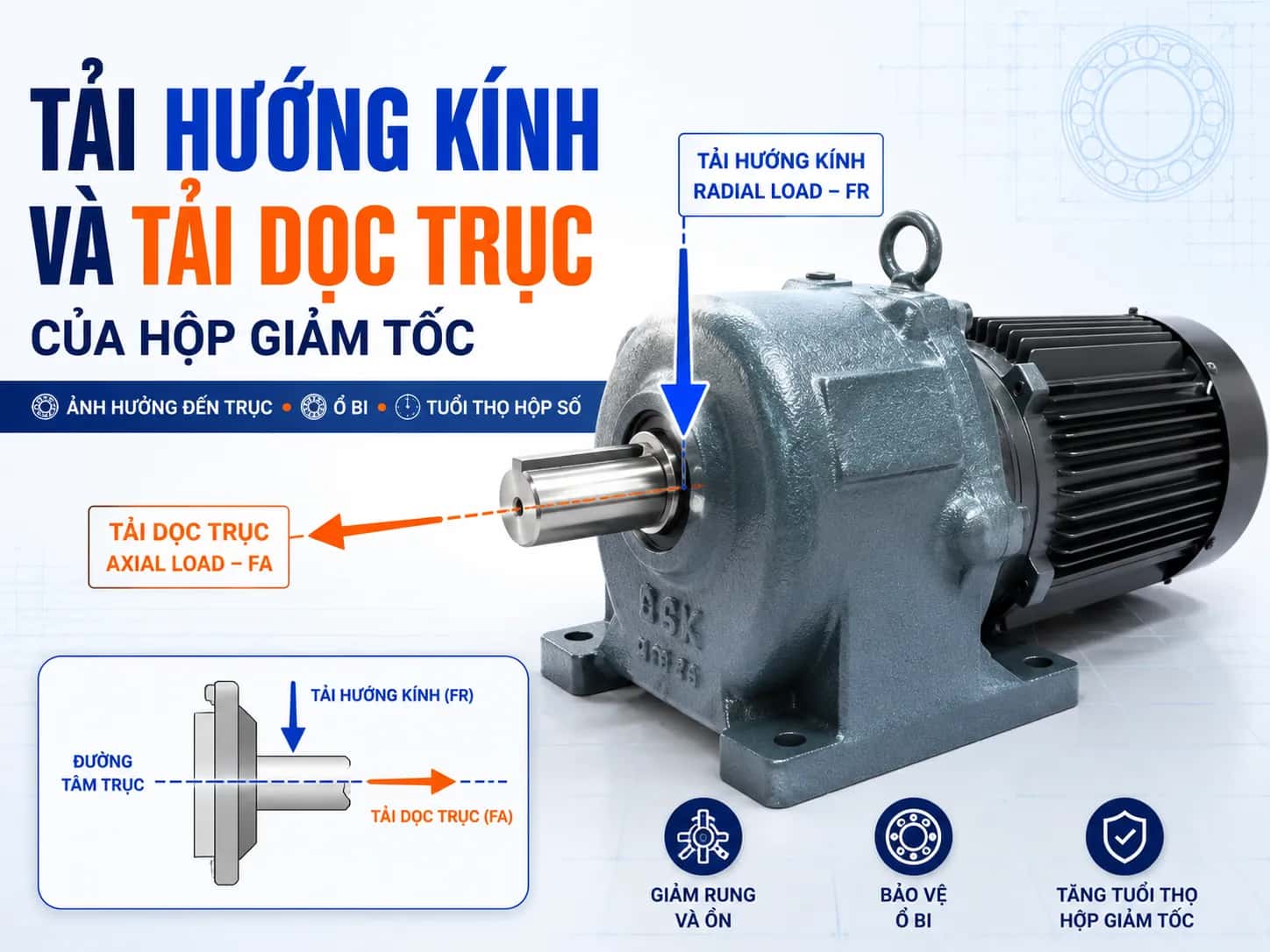
Radial load.
Axial load.
Thermal capacity.
Mounting position.
Input speed.
Type and quantity of lubricant.
Common mistakes
Selecting only based on motor power
For the same motor power, gearboxes can differ in torque, gear size, and load capacity.
Assuming Service Factor is 1.5
An SF of 1.5 may be excessive or insufficient depending on the application.
Confusing Service Factor with efficiency
Service Factor reflects the load safety margin. Efficiency represents the power transmission capability.
Ignoring radial load
A gearbox may have sufficient torque but still suffer bearing failure if sprockets or pulleys create excessive load on the shaft.
Not checking temperature
A gearbox with sufficient mechanical load capacity may still overheat when running continuously in an enclosed environment.
Information required when selecting a gearbox
Information | Required data |
|---|---|
Application | Conveyor, screw conveyor, mixer, etc. |
Motor power | kW |
Motor speed | rpm |
Output speed | rpm |
Load torque | Nm |
Operating duration | Hours/day |
Number of starts | Starts/hour |
Load characteristics | Uniform, variable, or shock |
VFD | Yes or no |
Drive type | Coupling, sprocket, pulley |
Mounting position | Horizontal, vertical, foot-mounted, flange-mounted |
Existing equipment | Nameplate photo and drawings |
Conclusion
Service Factor is a critical parameter when selecting a gearbox based on actual operating conditions.
To select the correct equipment, it is necessary to determine:
Load torque.
Operating time.
Number of starts.
Shock load level.
Peak load torque.
Radial and axial loads.
Thermal conditions and mounting position.
Do not select a gearbox based solely on motor power or apply a fixed Service Factor for all applications.
MDriveTech provides support for torque calculation, Service Factor verification, and selection of geared motors and gearboxes suitable for actual operating conditions.
Hotline: 0868 789 647
Email: [email protected]
Frequently Asked Questions
Can a Service Factor of 1.0 be used?
Yes, if the load conditions and operating time are consistent with the gearbox's rated parameters.
What Service Factor should be chosen for 24/7 operation?
There is no fixed value. It is necessary to consider the load type, number of starts, temperature, and heat dissipation capability.
Does using a VFD help reduce the Service Factor?
A VFD helps with smoother starting and stopping, but the gearbox must still meet the required load torque and peak load requirements.
Does a high Service Factor make a gearbox more durable?
A higher safety margin reduces the risk of overload, but service life also depends on installation, lubrication, temperature, and maintenance.
Can a gearbox be selected based solely on motor power?
No. It is necessary to check the output torque, gear ratio, Service Factor, shaft loads, and operating conditions.