What Are the Differences Between GGM Induction, Reversible, and Speed Control Motors?
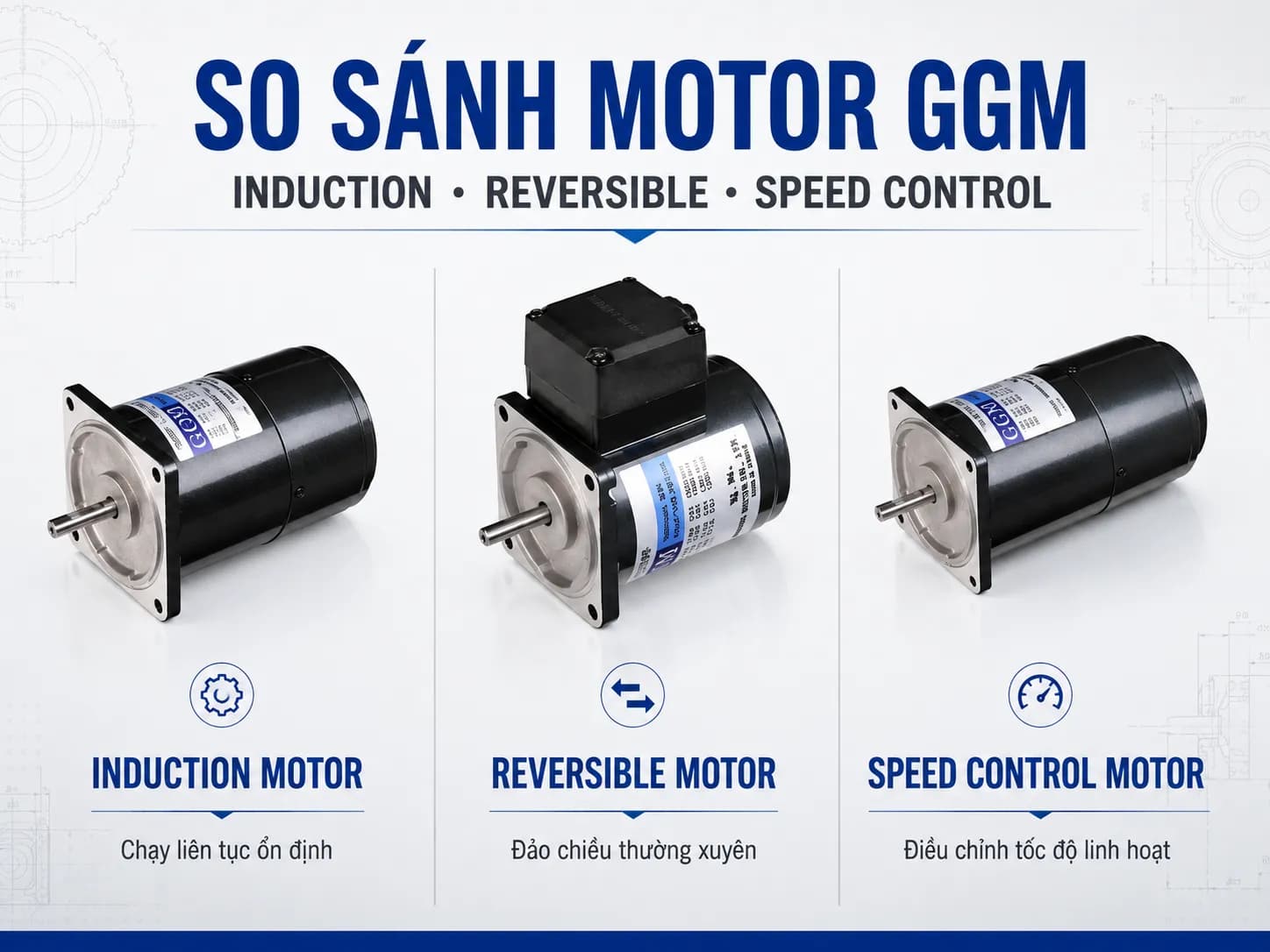
Compare GGM Induction, Reversible, and Speed Control motors. Learn about continuous operation, reversing capabilities, speed control, and how to select the right motor for your application.
What Are the Differences Between GGM Induction Motors, Reversible Motors, and Speed Control Motors?
GGM offers a wide range of small-capacity AC motors for automation machinery, mini conveyors, packaging machines, labeling machines, and OEM equipment. The three groups that are most often confused are Induction Motors, Reversible Motors, and Speed Control Motors.
The main difference lies in the operating purpose:
Induction Motor: Suitable for continuous operation at a relatively constant speed.
Reversible Motor: Suitable for mechanisms requiring frequent direction changes.
Speed Control Motor: Suitable for machines requiring speed adjustment and setting via a controller.
GGM Motor Quick Comparison Table
Criteria | GGM Induction Motor | GGM Reversible Motor | GGM Speed Control Motor |
|---|---|---|---|
Main Purpose | Continuous unidirectional operation | Frequent forward/reverse rotation | Motor speed adjustment |
Speed | Primarily based on power frequency and load | Primarily based on power frequency and load | Adjustable via compatible controller |
Reversing | Can be reversed according to the wiring diagram but not optimized for frequent reversing | Designed for frequent reversing | Depends on the induction or reversible type |
Speed Controller | Not required | Not required | Required to use the correct controller |
Duty Cycle | Generally suitable for continuous operation | Many models have a 30-minute rating | Depends on the base motor type and model |
Applications | Conveyors, fans, turntables, feeders | Door opening/closing, pushing, sliding, clamping mechanisms | Variable speed conveyors, labeling machines, packaging machines |
Common Code Identification | Contains character I | Contains character R | Usually has SP or SU suffix |
Specifications and part numbering must be cross-referenced with the exact model, as GGM offers various shaft, voltage, terminal box, and gearhead configurations.
What is a GGM Induction Motor?
A GGM Induction Motor is an AC induction motor suitable for mechanisms requiring stable long-term operation without frequent reversing.
GGM Induction Motors are currently manufactured in various small power ratings, from 6W to 200W, with different flange sizes and wiring configurations.
Induction Motors are suitable for:
Unidirectional conveyors.
Continuous-duty turntables.
Feeders.
Simple packaging machines.
Fans or rotating mechanisms.
Machines that do not require frequent speed changes.
Induction Motors can be combined with GGM gearheads to reduce speed and increase output torque. MDriveTech currently offers series such as K6I6N, K7I15N, K8I25N, K9I40N, and K10I200F along with their corresponding gearheads.
Important considerations
Induction Motors are not the optimal choice for mechanisms requiring frequent reversing or immediate stopping. After power is cut, the shaft may continue to rotate for a short distance due to the inertia of the motor and load.
What is a GGM Reversible Motor?
A Reversible Motor is an AC motor designed to be more suitable for applications requiring frequent forward and reverse rotation.
This series is typically used in:
Opening and closing mechanisms.
Small sliding doors.
Product pushing mechanisms.
Sliding tables.
Packaging machines.
Clamping and releasing mechanisms.
Components requiring back-and-forth movement.
GGM provides Reversible Motors from 6W to 180W, available in both lead wire and terminal box types.
How do Reversible Motors differ from Induction Motors?
Reversible Motors are better suited for:
Frequent starting and reversing.
Rapid switching between forward and reverse rotation.
Limiting coasting time when changing states.
Operating bidirectional motion mechanisms.
However, many GGM Reversible Motors are rated for 30-minute duty, such as the 25W and 60W series. This means that operating time, run/stop cycles, and motor temperature must be monitored, rather than assuming continuous operation as with an Induction Motor.
The 30-minute rating should not be interpreted as the motor being required to stop exactly at 30 minutes under all conditions. Actual operating time depends on the load, reversing cycle, heat dissipation capacity, and installation conditions; however, the limits specified in the catalog for the specific model must be strictly followed.
What is a GGM Speed Control Motor?
A GGM Speed Control Motor is a system consisting of an AC motor and a compatible speed controller. Operators can adjust the speed within the range specified by the manufacturer instead of running near the fixed speed of the power supply.
GGM offers the following groups:
SU Speed Control Motor.
SP Speed Control Motor.
SP Speed Control Reversible Motor.
Speed Control & Brake Motor.
The current GGM product range includes Speed Control Motor SU/SP from 6W to 180W and Speed Control Reversible Motor SP from 6W to 90W.
Speed Control Motors are suitable when:
Conveyor speed needs to be changed.
Feeding speed requires adjustment.
Labeling machines require basic speed synchronization.
Packaging machines require multiple speed levels.
Turntables need speed adjustment (faster/slower).
Product inspection machines require fine-tuning of speed.
Can a Speed Control Motor always be reversed?
No.
A Speed Control Motor describes the capability to adjust speed; it does not automatically imply that the motor is designed for frequent reversing.
GGM offers both:
Speed Control Induction Motor: prioritized for speed control and stable operation.
Speed Control Reversible Motor: designed for both speed control and better suitability for reversing.
For example, models with the reversible group designation and the SP suffix belong to the Speed Control Reversible Motor series. GGM specifically publishes ratings for 60W and 90W Speed Control SP Reversible combinations with a 30-minute duty cycle.
Which GGM motor type should be selected?
Select an Induction Motor when:
The machine runs in one direction.
Continuous operation is required.
The speed is relatively fixed.
A speed controller is not required.
A simple configuration is desired.
Select a Reversible Motor when:
The machine requires frequent forward and reverse rotation.
The mechanism involves back-and-forth movement.
Faster direction changes are required compared to standard induction motors.
The operating time matches the motor's rated duty cycle.
Select a Speed Control Motor when:
Speed changes via a knob or controller are required.
Machine speed must be adjusted according to each product.
Increasing or decreasing speed without changing the gearhead is necessary.
The system does not require precise position control like a servo.
Select a Speed Control Reversible Motor when:
Both speed adjustment and frequent reversing are required.
The operating cycle matches the published ratings.
The controller and motor are correctly matched.
Can the same gearhead be used for different GGM motor series?
GGM motors can be combined with gearheads to reduce speed and increase torque, but selection should not be based on power alone.
It is necessary to verify:
Motor flange dimensions.
Pinion shaft or straight shaft type.
Compatible gearhead series.
Gear ratio.
Permissible gearhead torque.
Output speed and radial load.
For example, 60, 70, 80, and 90mm motor sizes typically use corresponding gearhead groups such as K6, K7, K8, and K9; however, the exact gearhead code must be cross-referenced with the catalog and the motor's shaft structure. The GGM page on MDriveTech currently separates motors and gearheads by size to assist with selection.
Common mistakes when selecting GGM motors
Using an Induction Motor for continuous reversing applications
While a motor can be reversed using an appropriate wiring diagram, it does not mean it is optimized for frequent reversing cycles. In such cases, a Reversible Motor should be considered.
Selecting a Reversible Motor for continuous operation without checking the duty cycle
Many GGM Reversible Motor models are rated for 30 minutes. You must verify the correct model code in the catalogue before using it for long-term machine operation.
Purchasing a Speed Control Motor without a controller
A Speed Control Motor must be used with a compatible controller. Do not select a controller based solely on power output without verifying the series, wiring, and voltage.
Assuming a Speed Control Motor can always reverse
Speed control capability and reversing capability are two different requirements. If a machine requires both functions, you must select the correct Speed Control Reversible Motor series.
Selecting based only on power (W)
Two motors with the same power rating may differ in dimensions, speed, voltage, duty cycle, shaft type, and compatible gearhead.
Frequently Asked Questions
Is a GGM AC Motor an Induction Motor?
An Induction Motor is a category within GGM's AC Motor lineup. The AC category also includes Reversible Motors, Brake Motors, and various Speed Control Motor series.
Can a GGM Reversible Motor run continuously?
You must check the catalogue for the specific model. Many GGM Reversible Motor series are rated for 30 minutes, so do not assume they can be used as continuous-duty motors.
Does a Speed Control Motor require a VFD?
Not necessarily. GGM Speed Control Motors are designed to work with a compatible speed controller for the motor system. Do not replace the controller with a VFD unless the catalogue permits it.
Can I adjust the speed by changing the gearhead?
You can change the output speed by selecting a different gear ratio, but that is a fixed mechanical change. A Speed Control Motor allows for speed adjustment during operation within the limits of the motor and controller.
MDriveTech consultation for GGM motor selection
To correctly select a GGM Induction Motor, Reversible Motor, or Speed Control Motor, customers should provide:
Power supply.
Required power.
Output speed.
Actual torque or load.
Whether reversing is required.
Number of reversals per hour.
Continuous running time.
Whether speed adjustment is required.
Flange and shaft dimensions.
Gearhead or controller currently in use.
Conclusion
GGM Induction Motors are suitable for stable and continuous running mechanisms. Reversible Motors are suitable for machines requiring frequent reversing, but the operating duty cycle must be verified. Speed Control Motors are suitable when speed adjustment via a controller is needed; if the machine requires both speed control and reversing, the correct Speed Control Reversible Motor series must be selected.
📞 Hotline: 0868 789 647
📧 Email: [email protected]