Why Do Geared Motor Brakes Require a Rectifier?
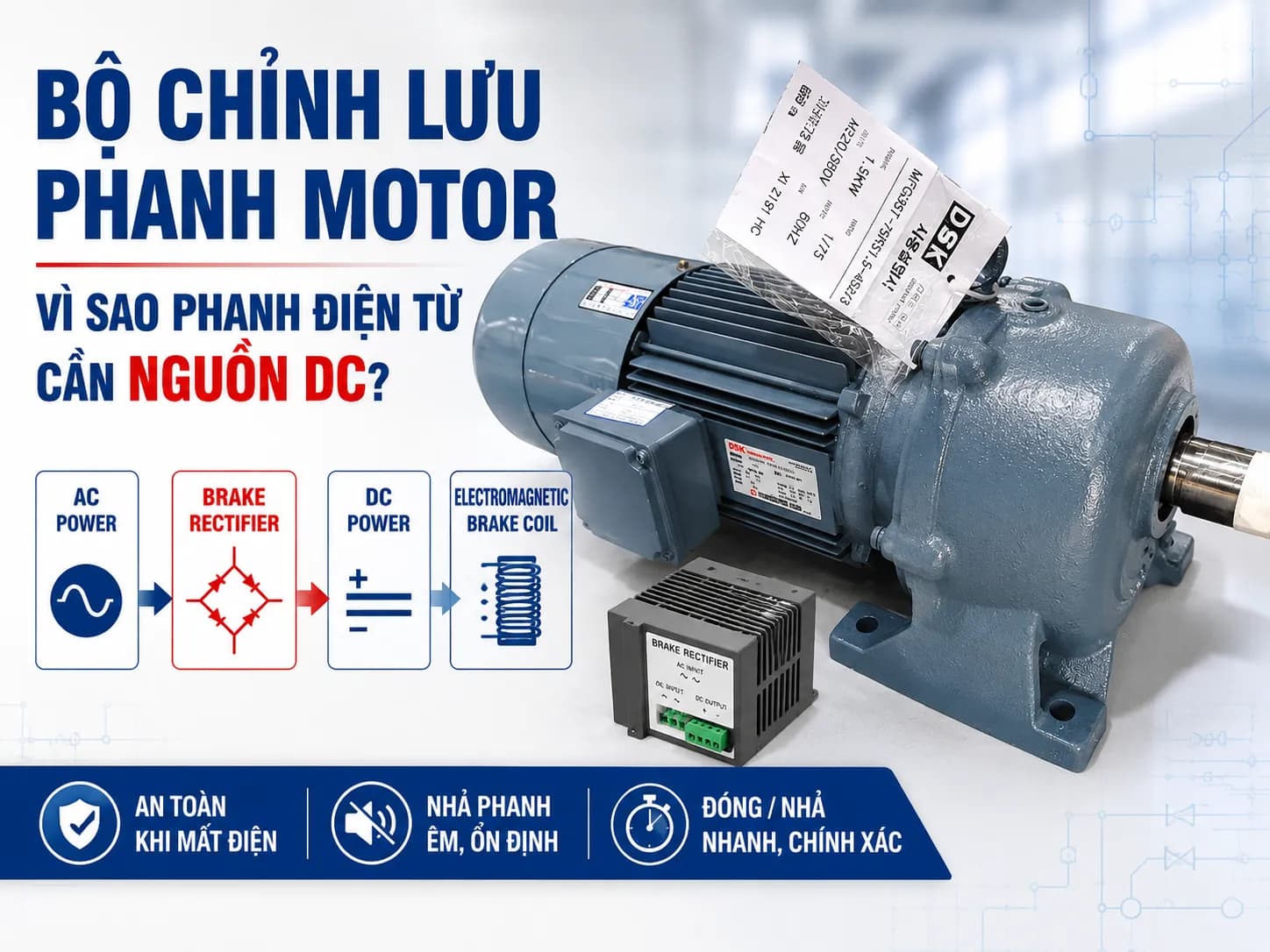
Discover why geared motor electromagnetic brakes utilize DC coils, the function of a brake rectifier, power supply methods, and how to troubleshoot brake release failures.
Why Do Geared Motor Electromagnetic Brakes Require a Rectifier?
Brake-equipped geared motors are widely used in conveyors, lifting equipment, packaging machines, winding machines, and systems that require stopping or holding loads at a fixed position.
On many industrial geared motors, the brake coil is designed to operate on DC power, while the factory power supply is typically AC 220V, 380V, or 400V. Therefore, the system requires a brake rectifier to convert the AC supply into the appropriate DC voltage for the brake coil.
What is a brake rectifier?
A brake rectifier is a device that converts AC power into DC power to supply the electromagnetic brake coil.
Basic operating diagram:
AC Power → Brake rectifier → DC Voltage → Brake coil
When the brake coil is energized, the electromagnetic force attracts the armature and releases the brake disc, allowing the motor to rotate. When power is lost, the spring forces the brake disc back to stop or hold the motor shaft.
This is the spring-applied, electromagnetic-release principle, which is commonly used to increase safety during power outages.
Why do brake coils typically use DC power?
It is possible to manufacture brakes that use AC power directly, but the coil and magnetic circuit must be specifically designed for an AC source.
Many manufacturers choose DC brake coils for the following reasons:
More stable electromagnetic attraction force.
Smoother brake release, less vibration, and less humming noise.
Easier control of brake engagement and release timing.
Convenient integration of fast-release or fast-engagement functions.
Easier to install within the motor terminal box or electrical cabinet.
AC power changes direction continuously and passes through zero periodically. If the electromagnetic mechanism is not properly designed for AC, the armature may vibrate or produce a humming noise. Meanwhile, DC current creates a more stable magnetic field while the brake is held in the released state.
Therefore, the following configuration is very common:
Factory AC power + brake rectifier + DC brake coil
Do brake-equipped geared motors always require a rectifier?
Not all brake-equipped motors require an external rectifier.
Brake Configuration | Is a rectifier required? |
|---|---|
DC brake coil, AC power supply | Usually required |
190VDC brake coil, only AC power available | Requires a suitable rectifier or brake controller |
24VDC brake coil, separate 24VDC power supply available | No rectifier needed |
Brake supplied with direct DC power | No rectification function needed |
Brake controller with integrated rectifier | No external unit needed |
Brake designed for direct AC operation | No rectifier needed |
On many AC gear motors with DC brake coils, the rectifier is typically installed in the motor terminal box or placed in the electrical cabinet.
Should a VFD-driven motor take brake power from U–V–W?
Generally, you should not supply the brake rectifier directly from the U–V–W output of a VFD.
The VFD output is a PWM voltage with variable frequency and voltage, not a fixed AC grid supply. If the rectifier is supplied from the VFD output, the brake may:
Fail to release completely.
Release slowly or inconsistently.
Overheat.
Drag while the motor is running.
Damage the rectifier or the brake coil.
The standard configuration is:
Fixed AC supply → Relay or contactor → Brake rectifier → Brake coil
The relay for engaging or releasing the brake can be controlled by the VFD relay output or a PLC.
Signs of a faulty brake rectifier
Some common symptoms include:
The motor is energized but does not rotate.
The motor produces a humming noise and the current increases significantly.
The brake does not release or only partially releases.
The motor rotates but the brake still drags.
The brake coil is abnormally hot.
The rectifier is burnt, cracked, or discolored.
No DC output voltage.
The brake engages or releases slowly.
However, a brake failing to release is not always caused by the rectifier. It is necessary to further inspect the brake coil, brake air gap, brake pads, armature, and control relay.
How to select a suitable brake rectifier
Before selecting or replacing a brake rectifier, you must confirm:
The brand and model of the gear motor.
The brake coil voltage.
The brake coil power or current rating.
The AC input voltage.
Whether it is a half-wave or full-wave rectifier.
The wiring diagram and number of pins.
The requirement for fast-acting or standard brake engagement.
Whether the motor is driven by a VFD.
The installation location (terminal box or electrical cabinet).
Do not replace a brake rectifier with a standard diode bridge without fully verifying the protection functions, current-carrying capacity, and the switching method of the brake coil.
Frequently Asked Questions
Why not supply AC directly to a DC brake coil?
DC brake coils are designed based on the voltage, current, and magnetic circuit characteristics of direct current. Supplying AC directly can cause the brake to vibrate, overheat, fail to release properly, or become damaged.
Can a faulty rectifier prevent the motor from rotating?
Yes. If the brake coil does not receive sufficient DC voltage, the brake will continue to hold the shaft, and the motor may fail to rotate, rotate weakly, or experience high current.
Can I supply DC190V directly to the brake coil?
Yes, provided that the DC source meets the manufacturer's requirements for voltage, current, power, and protection. The system may still require a DC relay or a surge suppression circuit when de-energizing the brake coil.
Does a 380V motor require a 380V brake?
No. The motor voltage and brake coil voltage are two separate parameters. An AC380V motor can still use a DC190V, DC90V, or other voltage brake coil depending on the design.
Conclusion
Brake rectifiers are commonly used on brake gear motors because many brake coils are designed to operate on DC power, while the power supply in factories is typically AC.
A brake rectifier helps convert AC power to DC to ensure stable brake release, minimal vibration, and easy control of engagement and disengagement timing. When selecting or replacing a rectifier, it is necessary to verify the brake coil voltage, input voltage, rectifier type, and the manufacturer's wiring diagram.
MDriveTech consultation for brake gear motors
MDriveTech provides support for inspection and selection of:
Brake gear motors.
Electromagnetic brake rectifiers.
Brake rectifiers for DC brake coils.
Troubleshooting motors that are powered but fail to release the brake.
Wiring brakes for VFD-driven motors.
Replacing burnt or damaged rectifiers.
Customers should provide the motor nameplate, brake coil label, old rectifier, wiring diagram, and the supply voltage currently in use.
Hotline: 0868 789 647
Email: [email protected]