Weak Gear Motor Rotation: Is It Electrical, Load, or Gearbox Related?
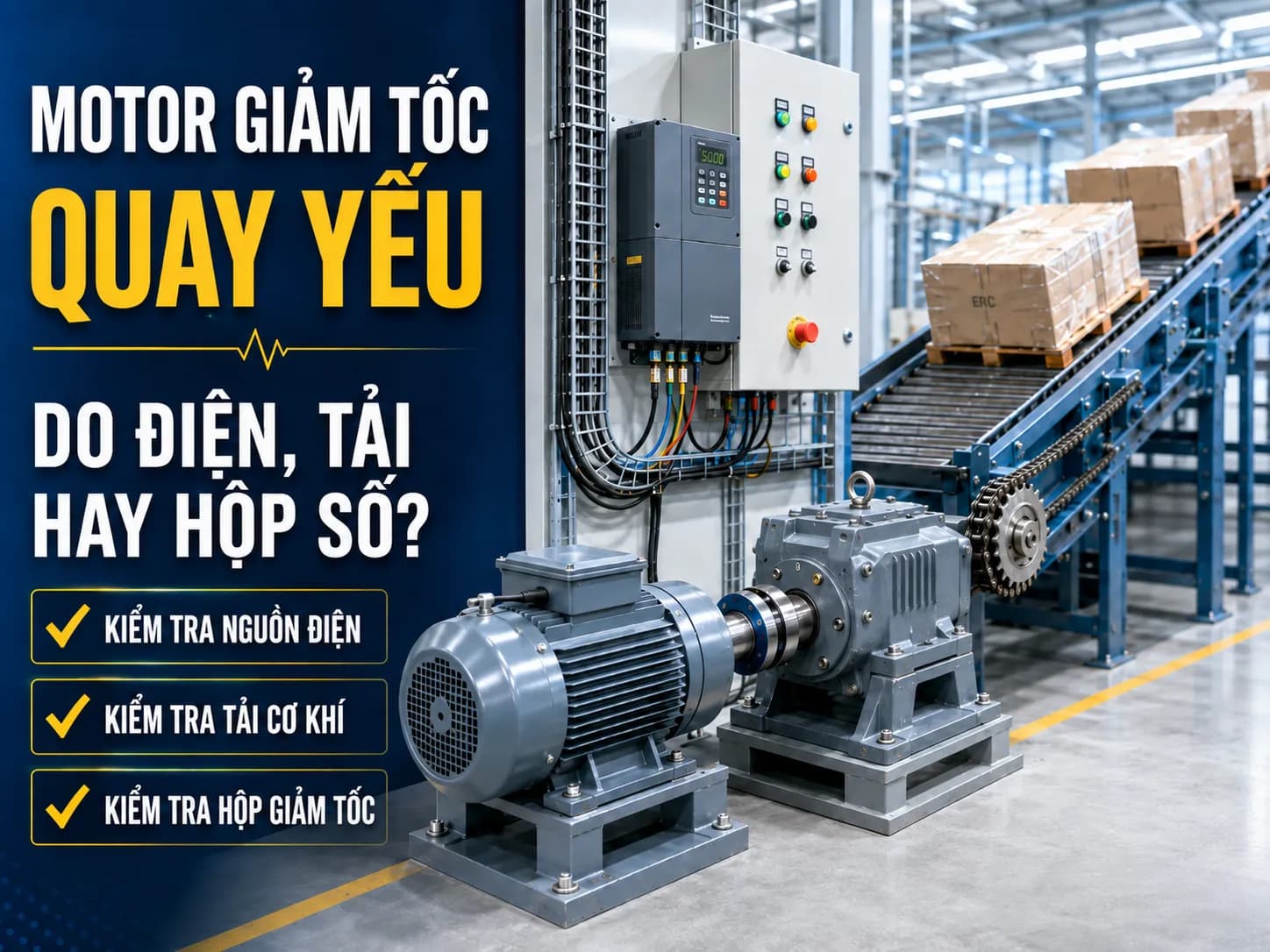
Gear motor rotation is weak due to low voltage, phase loss, overloading, incorrect VFD settings, or gearbox damage. Learn how to diagnose and resolve these issues effectively.
Weak Geared Motor Rotation: Is the Cause Electrical, Load-Related, or Gearbox-Related?
What Is Weak Geared Motor Rotation?
Weak geared motor rotation is a condition where the motor continues to operate but lacks sufficient torque to drive the load, resulting in reduced output speed, difficult starting, or stalling under increased load.
This fault commonly occurs in:
Industrial conveyor belts.
Agitators and mixers.
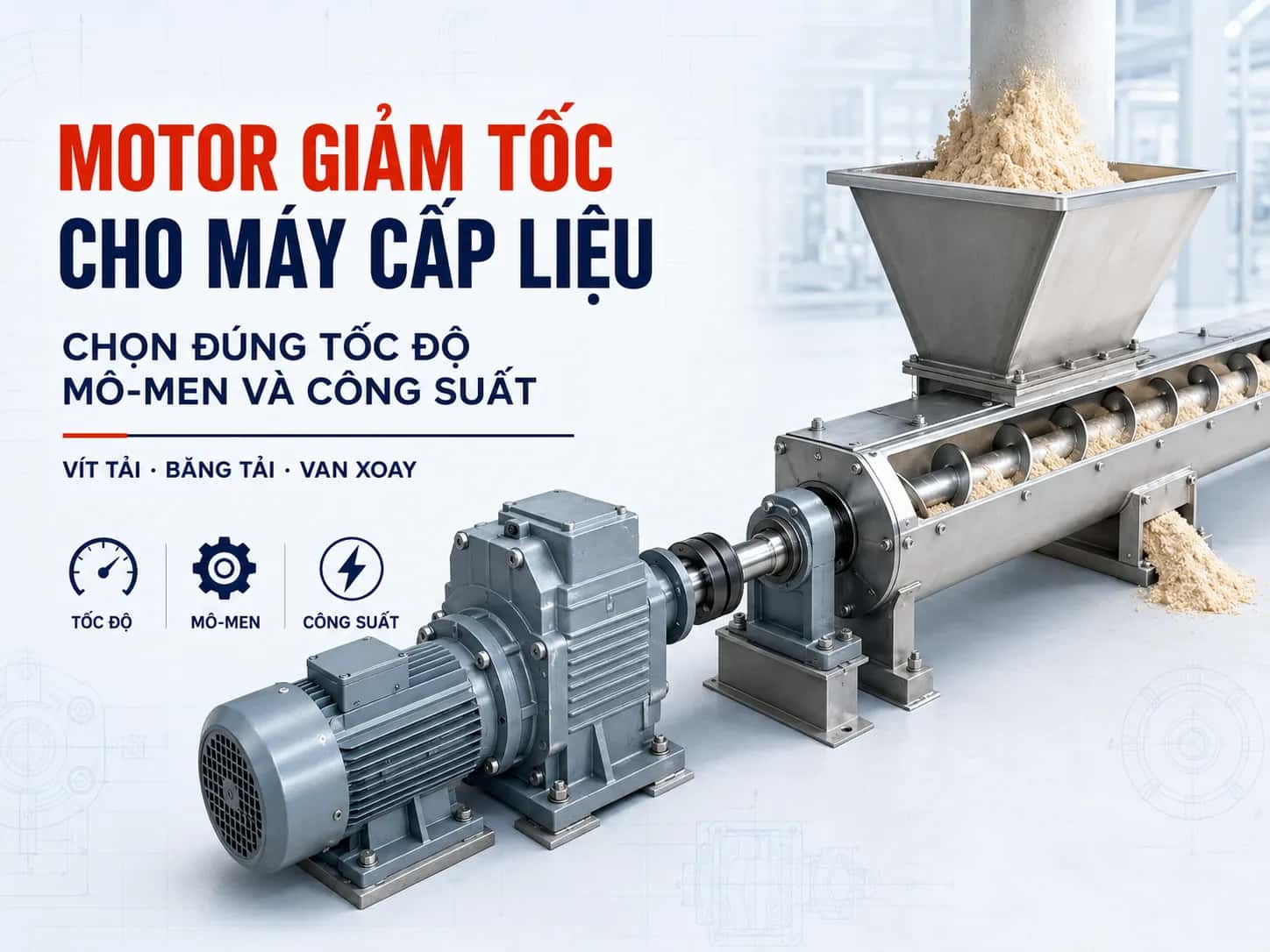
Screw conveyors and feeders.
Packaging machines.
Lifting and hoisting mechanisms.
Material handling lines.
The cause is not necessarily the motor itself. In many cases, the issue stems from the power supply, VFD settings, mechanical load, or the gearbox.
Therefore, it is necessary to check from the electrical side to the mechanical side sequentially instead of replacing the motor immediately.
Signs of a Weak Geared Motor
Common signs include:
The motor starts slower than usual.
The output shaft rotates but cannot drive the load.
A noticeable speed drop when material is loaded onto the conveyor.
The motor hums but the shaft does not rotate.
Current increases significantly under load.
The motor or gearbox overheats quickly.
The conveyor runs jerkily or unevenly.
The mixer stops when the material becomes denser.
The VFD frequently trips on overcurrent or overload.
The gearbox makes abnormal noise or vibrates.
If the motor rotates normally when unloaded but becomes weak after being connected to the machine, the cause is likely related to the mechanical load, motor power, or gear ratio.
Causes of Weak Geared Motor Rotation Related to Power Supply and VFD
1. Low or Unstable Supply Voltage
Low voltage reduces the motor's torque-generating capability. The motor may still rotate, but the pulling force is significantly reduced, especially during startup or when the load increases.
Common causes:
Voltage drop in the factory power supply.
Cables are too small or too long.
Loose, burnt, or oxidized connection points.
Poor contactor performance.
Power supply does not match the motor voltage.
Multiple high-power devices starting simultaneously.
It is necessary to measure the voltage at the motor input while the machine is running under load, not just when it is stopped.
If the voltage drops significantly during startup, check the power supply, cable cross-section, connections, and switching devices.
2. Motor Phase Loss or Phase Imbalance
For three-phase motors, the loss of one phase or unbalanced voltage between phases can cause the motor to rotate weakly, vibrate, overheat quickly, and produce a humming sound.
Common signs:
The motor is difficult to start.
Large current imbalance between the three phases.
The motor vibrates and overheats quickly.
Abnormal humming sound.
Thermal overload relay trips frequently.
Protection device indicates phase loss.
It is necessary to check:
Voltage between phases.
Current of each phase.
Fuses and contactors.
Power cables and motor terminals.
Winding resistance if motor damage is suspected.
Do not continue operation when the motor experiences phase loss, as the windings can burn out in a short period.
3. Incorrect Star-Delta Connection
Some motors allow for star or delta connection depending on the supply voltage and the specifications on the nameplate. If connected incorrectly, the motor may still run but fail to generate sufficient torque.
For example, a motor with a nameplate reading Δ 380 V / Y 660 V must be connected in delta when using a 380 V supply. If connected in star on a 380 V supply, the voltage across each winding is reduced, and the motor may lack pulling power.
When inspecting, compare the following:
Voltage specified on the nameplate.
Wiring diagram in the terminal box.
Actual supply voltage.
Current star or delta connection configuration.
Do not arbitrarily change the connection method without correctly reading the nameplate and the manufacturer's diagram.
4. Incorrect VFD Motor Parameter Settings
If a gear motor is operated via a VFD, incorrect parameter settings can cause the motor to be weak even if the mechanical components are normal.
Common errors include:
Incorrect motor power setting.
Incorrect rated current setting.
Incorrect rated speed setting.
Incorrect base frequency setting.
Acceleration time is too short.
Current limit or torque limit is set too low.
V/F mode selection is unsuitable for the load.
Autotune not performed when using vector control.
Output frequency is limited to a low value.
V/F characteristic curve is unsuitable.
For conveyors, agitators, screw conveyors, or heavy loads, it is necessary to check the control mode and the ability to generate torque at low speeds.
A VFD cannot fully compensate for an undersized motor or a gearbox with an incorrectly selected gear ratio.
5. Damaged Motor Windings or Rotor
A motor may rotate weakly if there are shorted turns in the windings, degraded insulation, or issues with the rotor.
Common signs include:
Unbalanced current between phases.
Motor heats up quickly even under light load.
Burning smell.
Abnormal speed reduction.
Motor vibration or humming noise.
Discrepancy in winding resistance between phases.
In this case, it is necessary to measure winding resistance, check insulation, and evaluate the motor using specialized equipment.
Causes of Weak Gear Motor Rotation Due to Mechanical Load
6. Motor or Gearbox Overload
Overload is one of the most common reasons why a gear motor lacks sufficient force.
This condition is often encountered when:
Conveyor is carrying excessive load.
Screw conveyor is full or jammed with material.
Agitator is working with materials thicker than designed.
Drive mechanism has high friction.
Machine capacity has been increased, but the old motor was retained.
Motor was selected too small for the actual load.
When overloaded, the motor typically exhibits high current, heats up quickly, and its speed drops when the load is applied.
It is necessary to compare the actual running current with the rated current on the nameplate. If the current consistently exceeds the rated value, the load, motor power, and required torque must be re-evaluated.
7. Jammed Mechanical Load or Excessive Friction
The geared motor may be perfectly normal but still rotate weakly if the machine mechanism is jammed or friction has increased significantly.
Points to check:
Load shaft bearings.
Conveyor rollers.
Chains, sprockets, and belts.
Couplings.
Screw conveyors.
Agitators.
Slide rails and guide bushings.
Mechanical brakes or electromagnetic brakes.
Material jammed in the machine.
If technical conditions permit, the geared motor can be disconnected from the load for a no-load test run.
If the motor rotates normally when the load is removed, focus on inspecting the mechanical parts of the machine.
Before disassembling or inspecting, disconnect the power, lock out the power source, and ensure the mechanism cannot move unexpectedly.
8. Undersized Motor Selection
The motor may run normally at no-load but lack sufficient torque when the load is applied if the selected power rating is too low.
In addition to the kW rating, check the following:
Starting torque.
Operating torque.
Output speed.
Service factor.
Number of starts per hour.
Continuous operating time.
Shock loads or variable loads.
Temperature and ventilation conditions.
Do not simply increase the motor power without considering the load capacity of the gearbox, shafts, couplings, and machine mechanism.
9. Electromagnetic Brake Not Fully Releasing
For geared motors with electromagnetic brakes, if the brake does not release completely, it creates continuous drag, causing the motor to rotate weakly and overheat quickly.
Possible causes include:
Incorrect brake coil voltage.
Faulty brake rectifier.
Incorrect wiring.
Incorrect brake air gap.
Worn or jammed brake disc.
Brake power not supplied at the correct time.
Asynchronous control logic between the VFD and the brake.
Common signs include the motor overheating, friction noise, or heavy rotation even under light loads.
10. Shaft or Coupling Misalignment
Misalignment increases the load on bearings, shafts, and couplings. The system may vibrate, overheat, and consume more power than normal.
This fault often occurs after:
Replacing the motor or gearbox.
Replacing the coupling.
Relocating the machine.
Loose mounting base.
Bent load shaft.
Deformed machine frame.
If the motor is both rotating weakly and vibrating, check the shaft alignment and the rigidity of the mounting base.
Causes Related to the Gearbox
11. Incorrect Gear Ratio Selection
The gear ratio directly affects the output speed and output torque.
Basic formula:
Gear Ratio = Motor Speed / Output Speed
If the gear ratio is too small, the output speed is high, but the torque may be insufficient to drive the load.
For example, if a conveyor requires low speed and high torque but the selected gearbox has a small gear ratio, the motor will have to work harder and is prone to weakness when the load increases.
When selecting the gear ratio, it is necessary to determine:
Motor speed.
Required output speed.
Motor power.
Load torque.
Service factor.
Start-stop frequency.
Do not select the gear ratio based solely on RPM while ignoring torque and load factors.
12. Insufficient Oil or Incompatible Gearbox Oil
Insufficient oil increases friction between gears and bearings. Oil that is too thick, too thin, degraded, or of the wrong type can also reduce transmission efficiency.
It is necessary to check:
Oil level according to the mounting position.
Oil color and odor.
Presence of metal particles.
Oil leakage status.
Oil type and viscosity.
Oil service life.
Do not arbitrarily add a different type of oil to the existing oil without verifying compatibility.
13. Worn Bearings
Worn or poorly lubricated bearings increase rotational resistance, forcing the motor to consume more power to drive the load.
Common signs:
Squealing or grinding noises.
Excessive gearbox vibration.
Irregular shaft rotation.
Rapid temperature rise.
Abnormal play in the output shaft.
Check the bearings and lubrication status before continuing operation.
14. Worn or Chipped Gears
Worn gears, incorrect backlash, or chipped teeth reduce transmission efficiency and cause loud noise.
Signs of identification:
Cyclic knocking sounds.
Loud gearbox noise.
Metal particles in the oil.
Irregular output speed.
Vibrating and hot gearbox.
Gradual loss of load-carrying capacity.
In this case, simply changing the oil will not solve the problem. It is necessary to inspect the gears, shafts, and internal clearances of the gearbox.
15. Loose or Deformed Output Shaft
A loose, bent, or worn output shaft at the coupling mounting point can cause instability in the power transmission system.
It is necessary to check:
Radial and axial play.
Shaft surface.
Key and keyway.
Coupling.
Shaft support bearings.
Concentricity with the load shaft.
If the shaft is deformed or severely worn, it is recommended to repair or replace the gearbox accordingly.
How to Determine if Motor Weakness is Due to Electrical, Load, or Gearbox Issues
Phenomenon | Priority Causes to Check |
|---|---|
Motor is weak even at no-load | Power supply, phase loss, wiring, or motor windings |
Normal at no-load but weak under load | Overload, insufficient power, or incorrect gear ratio |
Motor is hot with friction noise | Brake, bearings, or shaft misalignment |
Gearbox is noisy, vibrating, and hot | Insufficient oil, worn bearings, or worn gears |
Weak when running at low speed via VFD | VFD parameters, control mode, and torque limits |
Speed drops after long-term operation | Overheating, oil degradation, or increased friction |
VFD reports overcurrent during acceleration | Jammed load, excessive acceleration rate, or insufficient motor power |
MDriveTech Support for Gear Motor Inspection and Selection
MDriveTech provides and offers consulting support for gear motors, gearboxes, electric motors, VFDs, and industrial drive solutions.
MDriveTech provides support for:
Identifying the causes of weak gear motor rotation.
Checking power ratings and gear ratios.
Calculating output speed and torque.
Consulting on gear motors for conveyors, agitators, and screw conveyors.
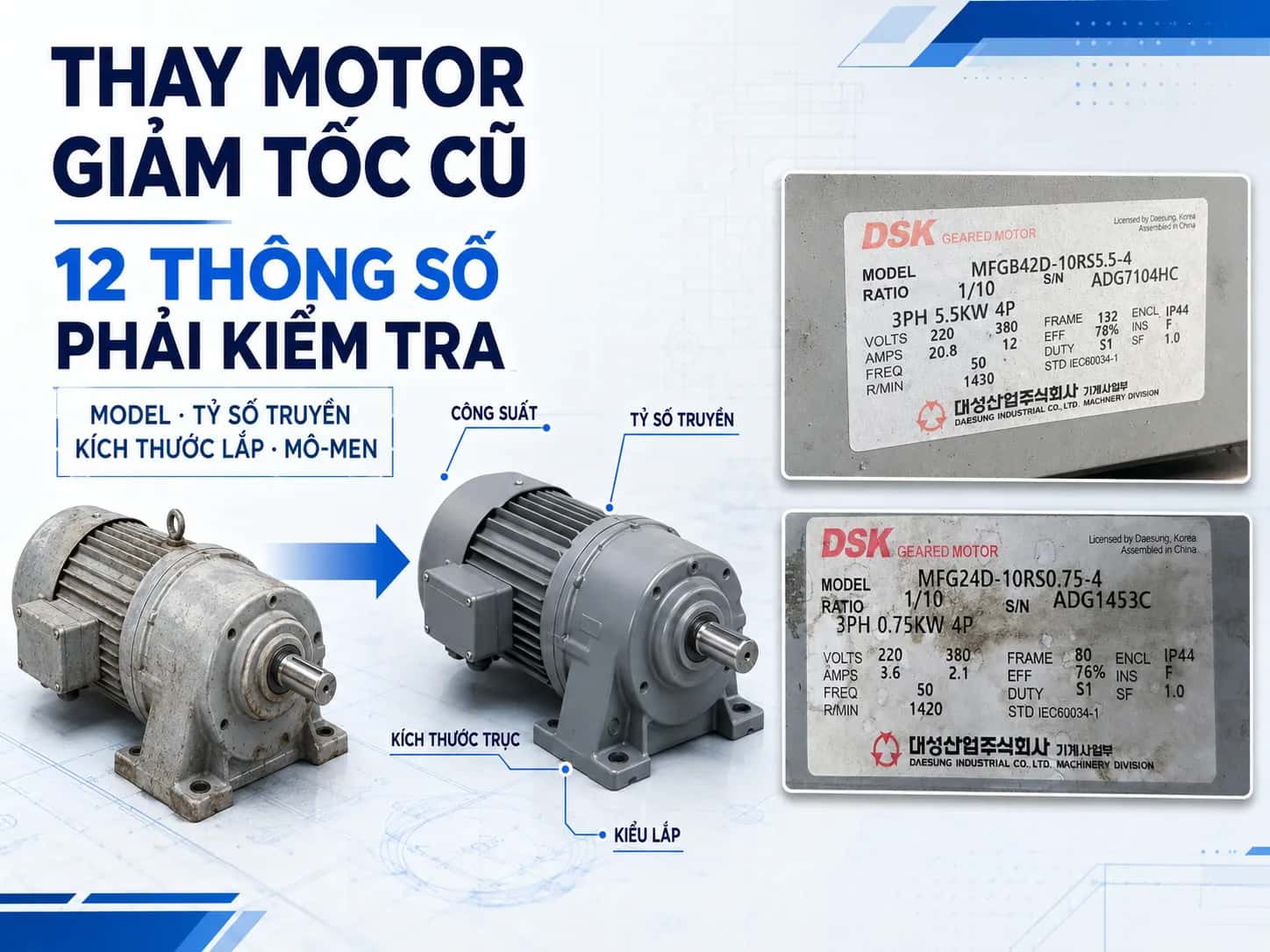
Cross-referencing DSK gear motor models.
Consulting on motor and VFD integration.
Recommending replacement models based on drawings and practical applications.
Contact MDriveTech for support in inspecting and selecting the appropriate gear motor for your load, speed, and actual operating conditions.
FAQ – Frequently Asked Questions
Why does the motor rotate but lack sufficient force?
Causes may include low voltage, phase loss, overloading, insufficient motor power, incorrect gear ratio, incorrect VFD settings, or increased friction in the gearbox.
Is a weak motor always caused by burnt windings?
No. It is necessary to check the power supply, VFD, mechanical load, and gearbox before concluding that the motor windings are damaged.
How can I determine if the motor is weak due to the load or the power supply?
You can measure voltage, current, and perform a no-load test. If the motor runs normally without a load but is weak after connecting the load, the cause is usually related to the load, power rating, or gear ratio.
Does a lack of oil in the gearbox cause the motor to be weak?
Yes. Lack of oil increases friction, raises temperature, and reduces transmission efficiency, causing the motor to work harder.
Does a brake that fails to release cause the motor to be weak?
Yes. If the brake does not release completely, it creates continuous resistance, causing the motor to rotate heavily, overheat quickly, and lack the force to pull the load.
Can I increase the VFD frequency to make the motor stronger?
It is not recommended. Increasing the frequency primarily increases speed and may reduce torque when running above the rated frequency. You should check the load, power rating, and gear ratio first.