How to Select the Right Geared Motor for Bucket Elevators
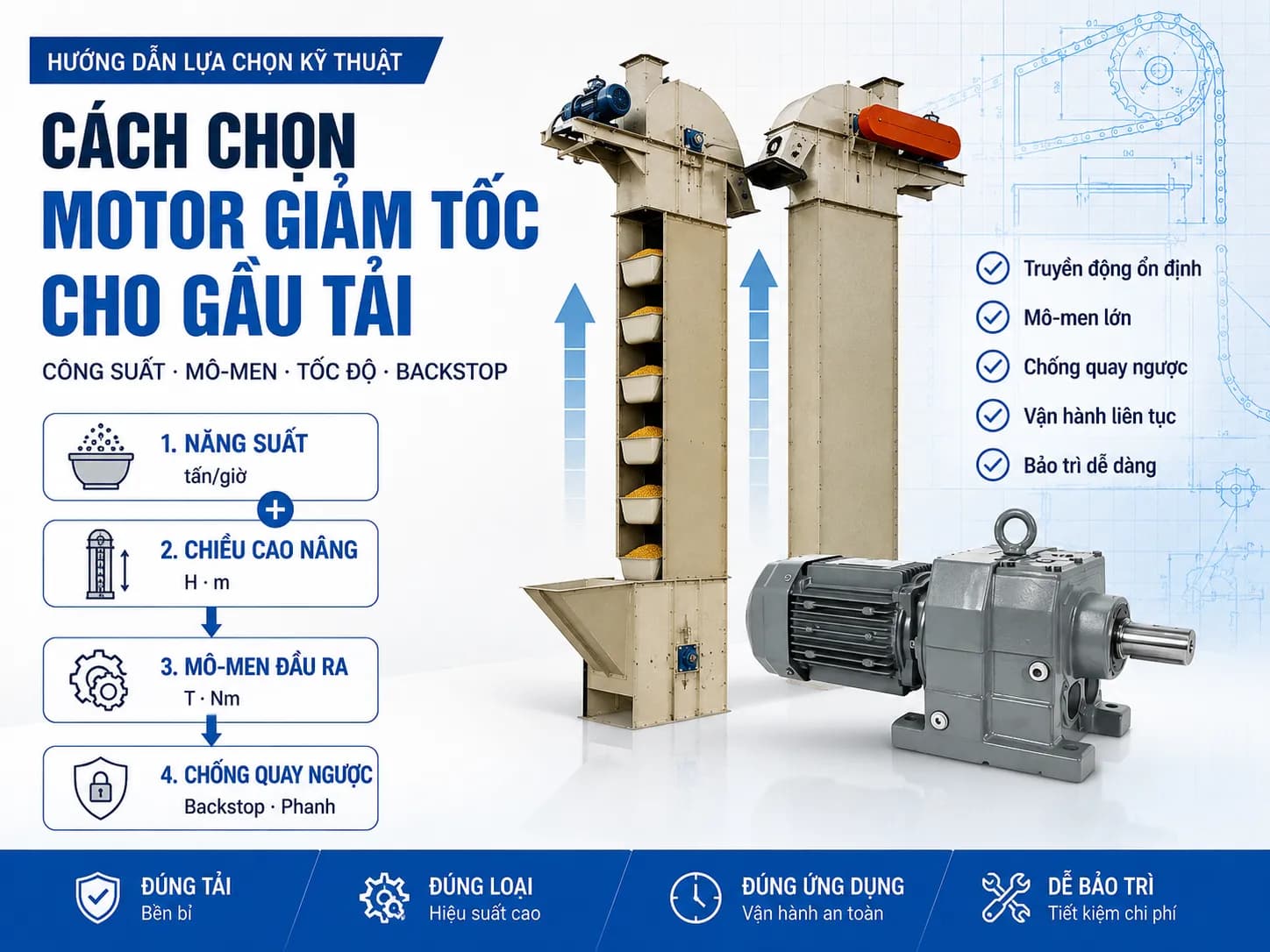
A comprehensive guide to selecting geared motors for bucket elevators, covering gearbox types, shaft configurations, operating loads, backstop requirements, and mounting arrangements.
How to Select the Right Gear Motor for Bucket Elevators
Bucket elevators transport materials vertically, requiring the drive system to operate with high torque, high starting loads, and the risk of reverse rotation during shutdowns. Therefore, selecting a gear motor for a bucket elevator should not be based solely on the old motor power or conveying capacity.
To make the right selection, it is necessary to determine the bucket elevator type, working load, output speed, operating time, shaft arrangement, and backstop requirements. For small bucket elevators, integral gear motors can be used; while heavy-duty or continuous-running systems often require a motor combined with a separate industrial gearbox.
1. Drive characteristics of bucket elevators
Bucket elevators use buckets mounted on belts or chains to move material from the boot to the discharge head. The motor and gearbox assembly is typically installed at the top, driving the head pulley or sprocket.
Compared to horizontal belt conveyors, bucket elevators have several specific requirements:
Load is lifted vertically.
Starting torque is typically high.
Risk of reverse rotation during power loss or machine shutdown.
Output shaft may be subject to high radial loads.
Many systems operate continuously in dusty environments.
Overload or material jamming can cause severe shock loads on the gearbox.
Therefore, in addition to motor power, it is necessary to check the output torque, gear ratio, shaft load, service factor, and backstop mechanism.
2. Distinguishing between belt and chain bucket elevators
The type of bucket elevator directly affects the speed, torque, and gearbox configuration.
Bucket elevator type | Operating characteristics | Drive solutions typically considered |
|---|---|---|
Belt bucket elevator | Relatively smooth operation, higher speed | Coaxial, parallel shaft, or bevel helical gear motor |
Single-chain bucket elevator | Low speed, higher mechanical load | Parallel shaft or bevel helical gearbox |
Double-chain bucket elevator | High torque, suitable for heavy materials | Heavy-duty gearbox or industrial gearbox |
Belt bucket elevators are typically used for grain, flour, and light materials. Chain bucket elevators are more suitable for cement, minerals, hot materials, or heavy-duty working environments.
3. Should you use an integral gearmotor or a separate gearbox?
This is the most critical selection step.
Integral gearmotor
The motor and gearbox are assembled as a complete unit.
Suitable when:
The bucket elevator has low or medium power.
The load is relatively stable.
Installation space is limited.
A compact design is required.
No auxiliary motor is needed for maintenance.
Torque and shaft loads are within the gearmotor's limits.
The main advantages are ease of installation, fewer couplings, and convenience for new equipment manufacturing. However, customization and load-bearing capacity may be more limited compared to separate industrial drive systems.
Motor combined with a separate gearbox
The motor, coupling, and gearbox are independent devices.
Should be considered when:
The bucket elevator has high power.
The lifting height is significant.
The system operates continuously 24/7.
Starting load is high.
There is a risk of material jamming.
A high-torque backstop is required.
An auxiliary motor is needed for slow-speed maintenance operation.
The plant prefers to replace the motor and gearbox separately.
A separate configuration is generally more suitable for heavy-duty bucket elevators because it is easier to select a gearbox based on specific torque, radial load, and maintenance requirements.
4. Selecting the gearbox type for bucket elevators
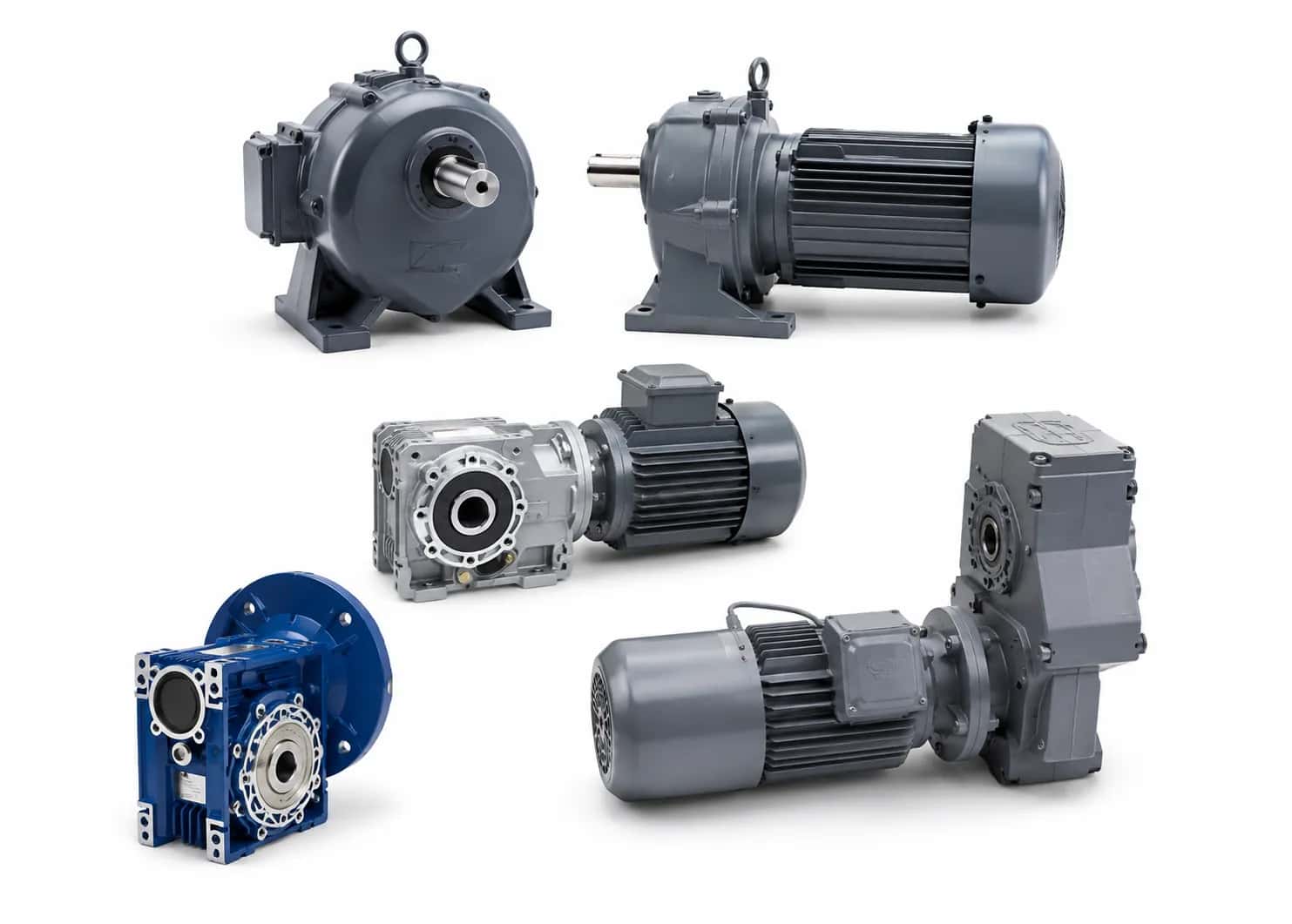
Coaxial helical gearbox
The input and output shafts are on the same axis.
Suitable for:
Small or medium-sized bucket elevators.
In-line drive arrangements.
Systems with sufficient longitudinal space.
Applications requiring good efficiency and easy maintenance.
It is necessary to check the rated torque and radial load if the output shaft is fitted with a sprocket.
Parallel shaft gearbox
The input and output shafts are parallel but offset.
This is a suitable choice for many bucket elevator systems because:
Compact structure in the horizontal direction.
Good torque transmission capability.
Easy to mount close to the bucket elevator casing.
Suitable for coupling or sprocket-chain drives.
Can use solid or hollow shaft configurations.
For chain bucket elevators or heavy-duty systems, parallel shaft gearboxes are often the preferred option.
Bevel helical gearbox
This type allows for a 90-degree change in transmission direction while maintaining high efficiency.
Suitable when:
The motor needs to be positioned parallel to the bucket elevator casing.
Longitudinal installation space is limited.
The system requires high torque.
The bucket elevator operates continuously.
Integration of a backstop or auxiliary motor is required.
For high-power bucket elevators, multi-stage bevel helical gearboxes are often more suitable than standard gearbox series.
Worm gearbox
Worm gearboxes have the advantage of being compact and easy to arrange at a right angle. However, careful evaluation is needed when using them for bucket elevators because their efficiency is generally lower than that of helical or bevel helical gearboxes.
This type should only be considered for:
Small bucket elevators.
Light-duty loads.
Non-demanding operating cycles.
Thermal and torque conditions within catalog limits.
The self-locking feature of a worm gear unit should not be assumed to be a complete substitute for a backstop.
Industrial Gearboxes
Recommended for use when:
The bucket elevator has high capacity.
The lifting height is significant.
The equipment is a critical link in the production line.
High availability is required.
The system operates continuously.
A backstop, auxiliary drive, or speed monitoring device is required.
This is the suitable solution for the cement, mineral, animal feed, and heavy-duty material handling industries.
5. When is a backstop required?
A backstop is a mechanical device that allows the shaft to rotate in the operating direction but locks it when the system tends to rotate in reverse.
Bucket elevators should be evaluated for backstop requirements when:
Material remains in the buckets during machine shutdown.
The belt or chain is prone to reverse movement.
The system operates in one direction only.
Reverse rotation could cause material spillage or impact damage.
The machine operates at significant heights.
Suspended loads generate significant reverse torque.
When selecting a backstop, it is necessary to determine:
Reverse torque capacity.
Mounting shaft speed.
Direction of free rotation.
Mounting position on the gearbox.
Lubrication conditions.
Compatibility with the gearbox model.
Do not attempt to retrofit a backstop onto a gearbox without confirmation from the manufacturer.
See more: What is a Backstop? How to Select a Backstop for Gearboxes
6. What is the difference between a backstop and a brake?
Backstops and brakes do not serve the same function.
Backstops are primarily used to prevent reverse shaft rotation. The device operates on a one-way principle and should not be used as a frequent stopping mechanism.
Electromagnetic brakes are used to stop and hold the shaft when the motor is de-energized or receives a stop command. Brakes are suitable for systems that require controlled stopping or load holding during operation.
Some bucket elevators may require both devices. The selection depends on the load, inertia, stopping time, and safety requirements of the machine.
7. When is an auxiliary drive required?
An auxiliary drive helps rotate the bucket elevator at a very low speed during:
System inspection.
Belt or chain alignment.
Bucket cleaning.
Clearing remaining material.
Maintenance and component replacement.
Troubleshooting when the main motor is not operational.
Auxiliary motors are typically connected to the main gearbox via an overrunning clutch. This solution is suitable for high-capacity bucket elevators that are difficult to rotate manually or have strict maintenance requirements.
8. Choosing between solid or hollow shafts
Solid shaft with coupling
Suitable when the gearbox and pulley shaft are arranged concentrically.
Advantages:
Direct drive.
No chain tension force applied to the shaft.
High efficiency.
Easy to inspect coupling condition.
The disadvantage is the requirement for precise concentric alignment.
Solid shaft with chain drive
Suitable when installation distance adjustment or an additional gear ratio stage is required.
Requirements for inspection:
Sprocket diameter.
Chain tension.
Sprocket position on the shaft.
Permissible radial load.
Distance from the sprocket to the shaft shoulder.
The further the sprocket is placed from the shaft shoulder, the greater the bending load on the shaft and bearings.
Hollow shaft for direct mounting
A hollow shaft allows the gearbox to be mounted directly onto the pulley or drive shaft.
Advantages:
Compact design.
Reduced number of couplings.
No complex alignment base required.
However, it requires a torque arm, a suitable locking assembly, and a plan for gearbox removal during maintenance.
9. Choosing between foot-mounted or shaft-mounted
Foot-mounted gearbox
Recommended when:
A sturdy machine base is available.
Drive is via coupling or chain.
Easy installation and removal are required.
Ease of alignment and maintenance is desired.
Shaft-mounted gearbox
Recommended when:
Installation space is limited.
The gearbox is mounted directly onto the pulley shaft.
A reduction in the number of couplings and machine base is desired.
The structure allows for the use of a torque arm.
When replacing with a different brand, it is necessary to compare drawings of the shaft, key, foot mount, torque arm, and maintenance clearance.
See more: What is the difference between foot-mounted and flange-mounted geared motors?
10. Choosing an electric motor for bucket elevators
The motor must meet the following requirements:
Sufficient power and starting torque.
Compatible with supply voltage and frequency.
Suitable duty cycle.
Protection class suitable for dusty environments.
Compatible with a VFD if speed control is required.
Equipped with a brake if the design requires it.
Meets the efficiency class required by the project.
VFDs are often used for soft starting, reducing starting current, and limiting impact loads on belts, chains, and gearboxes.
However, a VFD cannot compensate for a gearbox that lacks torque or has an incorrectly selected gear ratio.
11. Selection suggestions by application
Bucket elevator condition | Recommended solution |
|---|---|
Small bucket elevator, lightweight material | Coaxial or helical-bevel geared motor |
Medium bucket elevator, long operating hours | Parallel shaft or helical-bevel geared motor |
Chain bucket elevator, heavy load | Heavy-duty parallel shaft or helical-bevel gearbox |
24/7 continuous operation | Separate motor and gearbox |
High-capacity bucket elevator | Specialized industrial gearbox |
Risk of reverse rotation | Gearbox with integrated backstop |
Slow speed required for maintenance | Gearbox with auxiliary drive |
Narrow installation space | Parallel shaft or shaft-mounted gearbox |
Need to change drive direction | Helical-bevel gearbox |
The table above is for guidance only. Specific models must be verified based on torque, gear ratio, radial load, mounting type, and operating conditions.
12. Information required for selecting a bucket elevator gearmotor
For quick and accurate selection, customers should provide the following:
Information | Details to be specified |
|---|---|
Bucket elevator type | Belt, single chain, or double chain |
Capacity | Tons/hour |
Lifting height | Meters |
Material | Type, bulk density, moisture content |
Speed | Belt, chain, or output shaft speed |
Load condition | Empty or full load start |
Operating time | Hours/day |
Drive type | Coupling, chain, or direct mount |
Mounting type | Foot, flange, or shaft-mounted |
Safety requirements | Backstop, brake, or auxiliary motor |
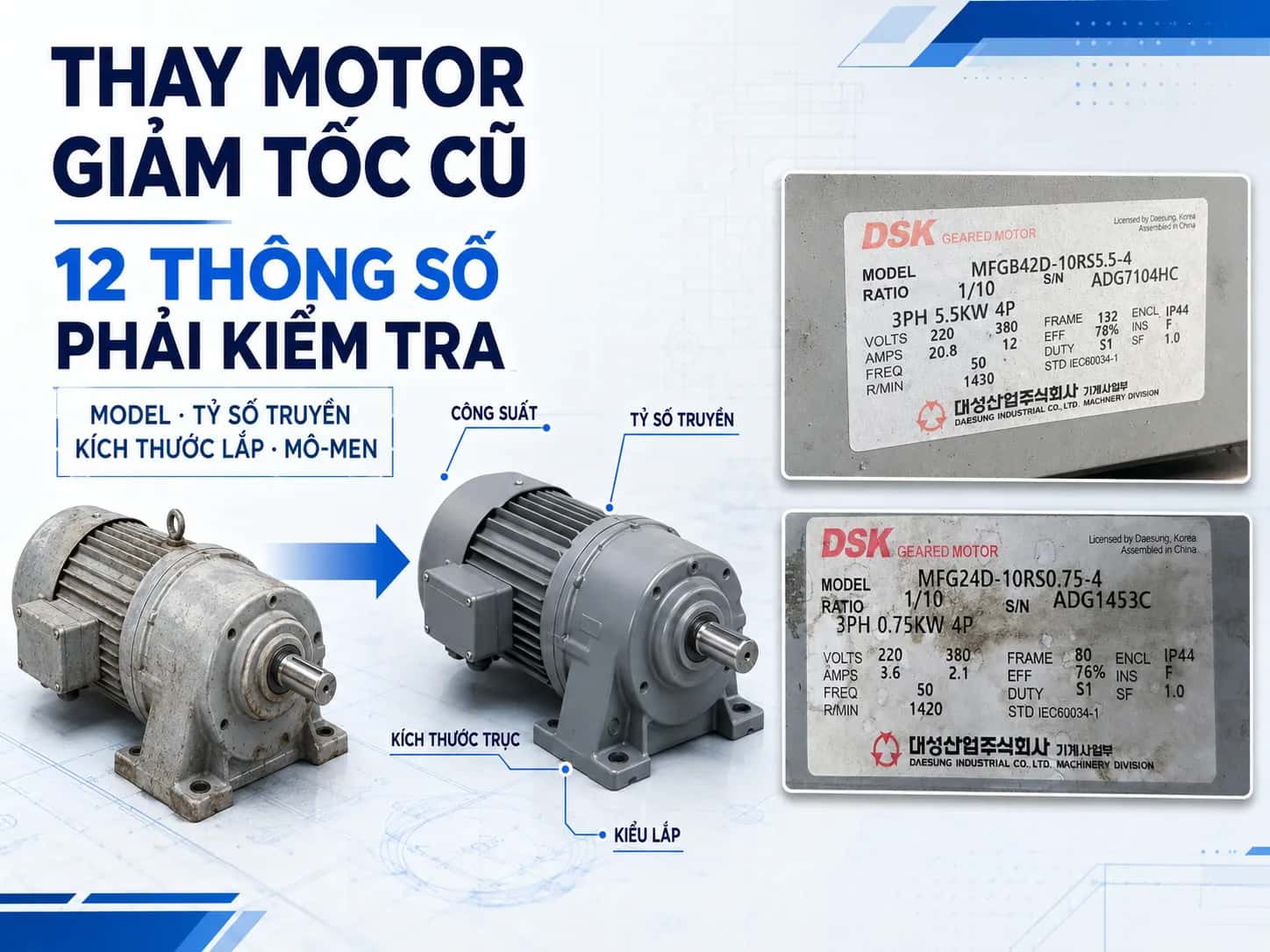
Existing equipment | Nameplate photo, drawings, and shaft dimensions |
For replacement purposes, it is recommended to also send photos of the entire drive assembly and its mounting position on the bucket elevator.
Common selection errors
Selecting the motor based solely on tons/hour capacity.
Failing to distinguish between belt and chain bucket elevators.
Using a standard gearmotor for heavy-duty applications.
Neglecting to check for reverse rotation risks.
Selecting the wrong backstop rotation direction.
Failing to verify radial load caused by sprockets.
Using a worm gear reducer without thermal verification.
Not considering 24/7 operating duty.
Increasing motor power while retaining the old gearbox.
Not verifying drawings before placing an order.
Conclusion
Selecting a gear motor for a bucket elevator requires focusing on the bucket elevator type, load level, operating time, drive arrangement, and backstop requirements.
Small and medium-sized bucket elevators can use integrated gear motors to optimize space and costs. For chain-driven, heavy-load, or continuous-duty bucket elevators, it is recommended to consider motors combined with parallel shaft, helical-bevel, or industrial gearboxes with backstops.
MDriveTech provides support for selecting gear motors and gearboxes for bucket elevators based on their structure and actual operating conditions. Customers can send images, drawings, old motor power ratings, output speeds, and backstop requirements to have suitable models verified.
📞 Hotline: 0868 789 647
📧 Email: [email protected]
Frequently Asked Questions
What type of gear motor should be used for a bucket elevator?
Small bucket elevators can use coaxial, parallel shaft, or helical-bevel gear motors. For heavy loads and long operating times, priority should be given to gearboxes with high efficiency, high torque capacity, and optional backstops.
Should worm gearboxes be used for bucket elevators?
They can be used for small and light-load bucket elevators. For systems running continuously or requiring high torque, it is necessary to carefully check the efficiency, operating temperature, and shaft load before selection.
When should separate motors and gearboxes be used?
They should be used when the bucket elevator has high power, heavy loads, operates 24/7, or requires a backstop and auxiliary motor. A separate configuration is also more convenient for maintenance and replacing individual components.
Can a VFD be used instead of a backstop?
No. A VFD controls the motor when the system is powered, while a backstop is a mechanical device that prevents reverse rotation. These two devices have completely different functions.
Can the motor power be increased while keeping the same gearbox?
This should not be done without checking the allowable torque of the gearbox. A larger motor may cause the gears, shafts, and bearings to exceed their design load limits.