Understanding M1–M6 Mounting Positions for Geared Motors
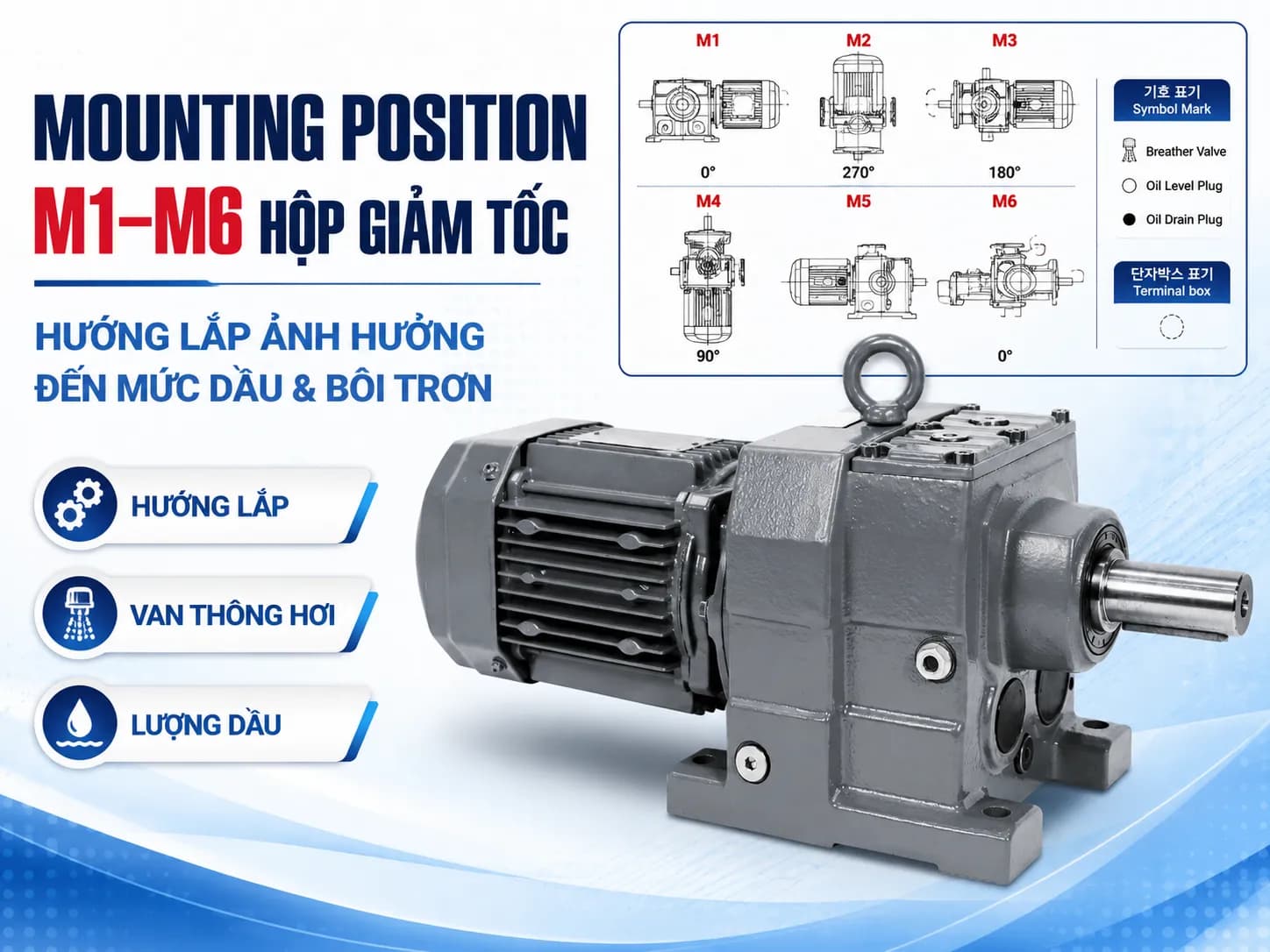
M1–M6 mounting positions define how a geared motor is installed, directly impacting oil levels, breather valve placement, and lubrication efficiency. Learn how to select the correct configuration.
What do the M1–M6 Mounting Positions for gearmotors mean?
The Mounting Position indicates the orientation of the gearmotor assembly during operation.
Each designation from M1 to M6 corresponds to a different orientation of the motor, gearbox, and output shaft. Depending on the mounting position, the motor can be horizontal, vertical, facing upward, facing downward, or rotated to either side.
However, a universal M1–M6 interpretation should not be applied to all gearmotors. The actual diagram depends on:
Coaxial gearmotors.
Parallel shaft gearmotors.
Right-angle gearmotors.
Foot-mounted or flange-mounted types.
Solid or hollow shafts.
Output shaft orientation.
Motor terminal box position.
Therefore, it is necessary to refer to the specific Mounting Position diagram for the selected series and configuration.

Figure 1: Mounting Position M1–M6 diagram for DSK DR Series gearmotors..
How does the Mounting Position affect oil quantity?
The Mounting Position applies to the entire gearmotor assembly, but the oil quantity and oil plugs are located on the gearbox section.
When the equipment assembly is rotated to a different orientation, the position of the gears and bearings relative to the oil level also changes. Therefore, for the same gearbox size, the oil quantity may differ between M1, M2, M3, M4, M5, and M6.
If the oil quantity is incorrect, the gearmotor may experience the following issues:
Insufficient lubrication for gears or bearings.
Excessive oil churning due to overfilling.
Increased gearbox temperature.
Oil leakage through the breather valve or seals.
Reduced service life of gears and bearings.
For example, the DSK catalog specifies the reference oil quantity for the DR87 as follows:
Mounting Position | Reference oil quantity |
|---|---|
M1 | 5.6 liters |
M2 | 7.8 liters |
M3 | 7.2 liters |
M4 | 8.3 liters |
M5 | 7.5 liters |
M6 | 7.5 liters |
The oil quantity in the table is a recommended value. The exact value may vary depending on the gear ratio and the number of gear stages. When filling oil, it is necessary to check the oil level indicator plug of the equipment.
Breather valve and oil plug positions
Each Mounting Position requires a specific arrangement of the breather valve and oil plugs.
Breather valve
The breather valve is typically located at a high position to balance the internal pressure of the gearbox as the oil temperature rises.
If the breather valve is located below the oil level, oil may overflow or leak during operation.
Oil level check plug
The check plug is positioned at the height corresponding to the operating oil level. When the oil reaches this position, the oil quantity in the gearbox has reached the required level.
Oil drain plug
The drain plug is usually located near the lowest point of the gearbox housing so that old oil can be drained during maintenance.
Is it possible to change the gear motor from M1 to M4?
It is possible in some cases, but you should not simply rotate the gear motor assembly and operate it immediately.
Before changing the Mounting Position, you must check:
Whether the model supports the new mounting position.
How much the oil quantity needs to be adjusted.
Where the breather valve must be relocated.
Whether the oil check plug is still at the correct height.
Whether the oil drain plug is at the lowest point.
Whether the motor orientation and terminal box interfere with the machine structure.
Whether the direction of the load applied to the shaft and bearings changes.
Whether the space for disassembly and maintenance is suitable.
Some gearbox housings have multiple pre-drilled holes for changing the positions of valves and oil plugs. However, this does not mean that the gear motor can be mounted in any orientation without re-verifying the lubrication configuration.
What to check before operating a gear motor?
Before starting, it is necessary to check:
The actual Mounting Position matches the ordered configuration.
The motor and output shaft orientations match the machine drawings.
The terminal box is not obstructed.
The breather valve is in the correct position.
The oil has been filled sufficiently.
The oil level is within the permitted limits.
The oil plugs are securely tightened.
There are no signs of oil leakage at the seals or mating surfaces.
Common errors when selecting Mounting Position M1–M6
Specifying only "horizontal mounting" or "vertical mounting"
This description does not fully specify the orientation of the motor, output shaft, and terminal box.
Changing the mounting orientation but keeping the oil quantity the same
The oil quantity suitable for M1 may be insufficient or excessive when changing to M2, M3, or M4.
Placing the breather valve at the bottom
Oil may leak through the valve when the internal temperature and pressure increase.
Not checking the oil level indicator plug
The oil quantity in the table is only a reference value. The actual oil level must be verified at the oil level indicator plug.
Using diagrams from a different series
DR, DF, DK, and DS have different structures. It is necessary to use the correct diagram for the actual model.
Not confirming the terminal box orientation
The motor may fit, but the terminal box might be obstructed by the machine frame or make power cable connection difficult.
Conclusion
The M1–M6 Mounting Position of a geared motor determines the orientation of the entire motor assembly, gearbox housing, output shaft, and terminal box.
The mounting orientation also affects:
The oil level in the gearbox.
Lubrication efficiency.
The position of the breather valve.
The position of the oil inspection and drain plugs.
Installation and maintenance space.
Do not change the Mounting Position without verifying the oil level, the position of oil plugs, and the motor orientation.
MDriveTech assists in determining the Mounting Position and selecting the DSK geared motor based on drawings, output speed, and actual installation space.
Hotline: 0868 789 647
Email: [email protected]
Frequently asked questions about the M1–M6 Mounting Position of geared motors
Is M1 always a horizontal mounting position?
M1 is typically the standard horizontal position in the DR Series diagrams. However, it is necessary to cross-reference the specific series diagram and the mounting type being used.
Can an M1 geared motor be installed in an M4 position?
Changes should only be made after verifying the oil level, breather valve, oil level plug, motor orientation, and the model's support capabilities.
Does the Mounting Position change the gear ratio?
No. However, the mounting orientation affects lubrication, temperature, and operational stability.
Why do M1–M6 require different oil levels?
Because the positions of the gears and bearings relative to the oil level change when the entire geared motor assembly is rotated.
Does the terminal box orientation need to be confirmed?
Yes. The terminal box orientation must be compatible with the cable routing, machine structure, and maintenance space.
Can I just send a photo of the nameplate to select the Mounting Position?
A nameplate photo helps identify the model but does not fully show the mounting orientation. It is recommended to send additional overall photos or drawings of the installation location.