Global Motor Voltage Standards: Understanding the Differences Between 380V, 400V, 415V, 440V, and 460V
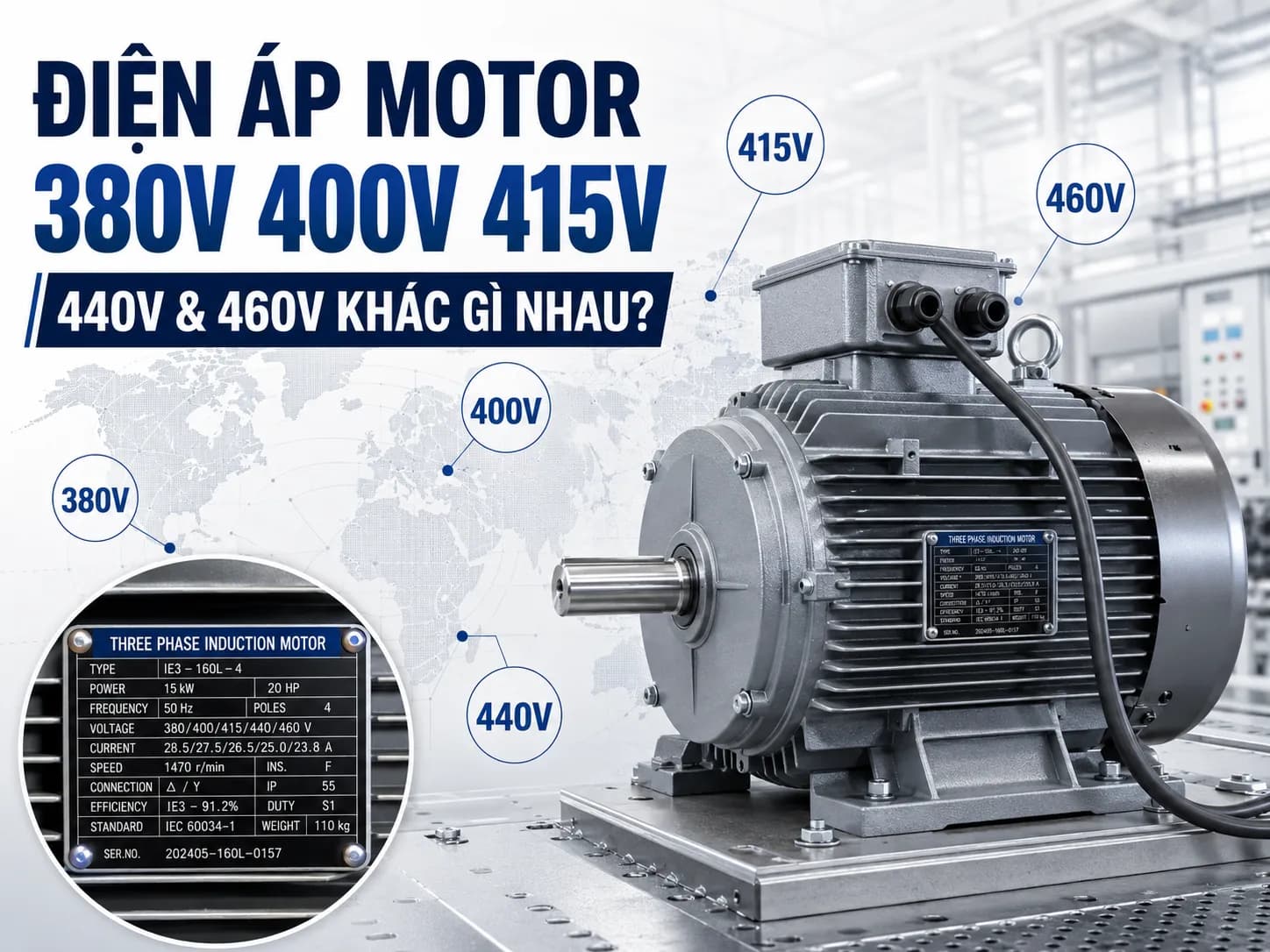
An explanation of 380V, 400V, 415V, 440V, and 460V motor voltages according to IEC/NEMA standards and how to select the right one for industrial applications.
Global Motor Voltage Standards: How Do 380V, 400V, 415V, 440V, and 460V Differ?
Motor voltage is more than just 380V or 400V
When reviewing the nameplate of a 3-phase electric motor, many people often encounter parameters such as 380V, 400V, 415V, 440V, 460V, or a range like 380–440V. This is a common source of confusion when selecting new motors, replacing old ones, or using imported motors from Europe, the US, Japan, South Korea, or China.
In reality, motor voltage cannot be interpreted as a single figure. When selecting a motor, the following must be considered simultaneously:
Rated voltage
Frequency
Rated current
Connection type (star / delta)
Power
Rotational speed
IEC or NEMA design standards
Actual load conditions
Direct-on-line operation or VFD operation
A motor rated for 400V/50Hz will differ from one rated for 460V/60Hz. A motor labeled 380–440V does not mean that any voltage within that range will yield the same performance. To make the correct selection, it is necessary to understand motor voltage rules according to each standard system.
3-phase motor voltage is line-to-line voltage
For 3-phase electric motors, the voltage indicated on the nameplate is typically the voltage between two phases, also known as line-to-line voltage.
For example:
A motor marked 380V means the voltage between L1–L2, L2–L3, or L3–L1 is 380V.
A motor marked 400V means the voltage between two phases is 400V.
A motor marked 460V means the voltage between two phases is 460V.
Do not confuse 3-phase motor voltage with phase-to-neutral voltage.
For example, a 230/400V power system means:
230V is the voltage between phase and neutral.
400V is the voltage between two phases.
For industrial 3-phase motors, the value of interest is typically 400V, not 230V.
Why are there so many different motor voltage levels worldwide?
Motors are manufactured to suit the electrical systems of various countries. Each region has a different history of grid development, design standards, and power frequencies.
Some common voltage groups include:
Region / Standard | Common 3-phase voltage | Frequency |
|---|---|---|
Vietnam | 380V | 50Hz |
Europe / IEC | 400V | 50Hz |
UK, Australia, Malaysia, UAE | 415V | 50Hz |
USA / NEMA | 230V, 460V, 575V | 60Hz |
Canada | 208V, 240V, 600V | 60Hz |
Japan | 200V | 50Hz or 60Hz |
South Korea | 380V | 60Hz |
China | 380V | 50Hz |
Other industrial systems | 440V, 480V | 50Hz or 60Hz |
Therefore, when importing motors from other markets, do not focus solely on the power rating in kW. Even for a 5.5kW motor, the voltage, frequency, rated current, and connection method may differ.
What is 380V? Why is 3-phase 380V power commonly referred to in Vietnam?
In Vietnam, 3-phase industrial power is commonly referred to as 380V/50Hz. This voltage level is very common in factories, workshops, pump systems, fans, conveyors, agitators, packaging machines, air compressors, and automated production lines.
When a motor is labeled:
380V / 50Hz
or
380–415V / 50Hz
or
380–440V / 50Hz
it can generally be considered for use with a 3-phase 380V power supply in Vietnam, but the rated current, connection type, and load conditions must still be verified.
In practice, the voltage at a factory is not always exactly 380V. In some places, it may measure 370V, 390V, 400V, or fluctuate depending on the load at the time. If the voltage is low while the motor is driving a heavy load, the motor may draw increased current, heat up quickly, and easily trip the protection devices.
What is 400V? Why do European countries use 400V/50Hz?
Under IEC and European standards, the common 3-phase voltage is currently 400V/50Hz. This is the line-to-line voltage of a 3-phase low-voltage system.
European motors typically have a nameplate like this:
230/400V Δ/Y – 50Hz
or:
400/690V Δ/Y – 50Hz
Reading this correctly is crucial.
If the motor is labeled:
230/400V Δ/Y – 50Hz
then:
Using a 3-phase 230V power supply → connect in delta Δ.
Using a 3-phase 400V power supply → connect in star Y.
If the motor is labeled:
400/690V Δ/Y – 50Hz
then:
Using a 3-phase 400V power supply → connect in delta Δ.
Using a 3-phase 690V power supply → connect in star Y.
This is a very common error when replacing motors. If the star/delta connection is incorrect, the motor may suffer from low torque, overheating, overcurrent, or winding damage.
Can 380V and 400V be used interchangeably?
In many cases, a 400V/50Hz motor can run on a 380V/50Hz system if the nameplate and catalog allow it. However, 380V and 400V should not be considered completely identical.
The reason is that when the voltage drops from 400V to 380V, the motor may experience a reduction in torque capability, especially under heavy loads or during direct-on-line starting. For light loads such as fans, centrifugal pumps, or light conveyors, this difference is usually not significant. However, for heavy loads such as crushers, presses, agitators for viscous materials, screw conveyors, or heavy-duty conveyors, more careful verification is required.
When using a 400V motor on a 380V power supply, you should check:
Motor rated current
Actual current under load
Motor temperature during operation
Starting torque
Acceleration time
Overload or VFD selection
Actual voltage at the motor terminals
If the motor frequently overheats or trips the overload protection, the cause may not lie with the motor itself, but rather with the supply voltage, mechanical load, or power rating selection.
What is 415V? Why do some countries use 415V?
The 415V/50Hz voltage is common in countries following British standards or markets previously influenced by this system, such as Malaysia, Singapore, Australia, the UAE, Qatar, Oman, or certain industrial sectors.
Motors rated at 415V/50Hz are generally close to the 400V/50Hz and 380V/50Hz voltage groups. However, when used in Vietnam, it is still necessary to verify the motor's allowable operating range.
If a motor is rated only for 415V/50Hz, using it with a 380V supply may result in an undervoltage condition of approximately 8–9%. It might operate under light loads, but for heavy loads, current and operating temperature must be monitored.
If the motor is rated for a range:
380–415V / 50Hz
it is more suitable, as the manufacturer has permitted the motor to operate within this voltage range.
What is 440V? Is it a European standard?
440V is not the most common voltage level in current European standards. This level is typically found in certain industrial systems, wide-range motors, or systems associated with 60Hz.
For example, some motors may be labeled:
380V / 50Hz – 440V / 60Hz
or:
380–440V
This is usually related to the voltage-to-frequency ratio, known as the V/f ratio.
For example:
380V / 50Hz = 7.6 V/Hz
440V / 60Hz = 7.33 V/Hz
These two values are relatively close, which is why some motors are designed to be used in both 50Hz and 60Hz markets.
However, one should not assume that a 440V/60Hz motor will necessarily perform well at 380V/50Hz. It should only be used when the nameplate or catalog explicitly states the parameters for both modes.
What is 460V? Why are US motors often rated at 460V?
In the US and some North American markets, motors typically follow the NEMA standard. Common motor voltages are 230V, 460V, 575V at a frequency of 60Hz.
Many people wonder why the US grid is typically referred to as 480V while motors are rated at 460V. The reason is that 460V motors are designed to operate within a 480V system, accounting for line voltage drop and actual operating conditions.
NEMA motors may be labeled:
230/460V – 60Hz
How to interpret this:
Can be connected to a 230V 3-phase supply.
Can be connected to a 460V 3-phase supply.
Must be wired according to the correct diagram for the voltage used.
The rated current at 230V will be higher than the current at 460V.
When using a 460V/60Hz motor in Vietnam, great caution is required. If the factory supply is 380V/50Hz, it should not be used directly unless the motor has 380V/50Hz or 400V/50Hz specifications on the nameplate.
Quick comparison table for 380V, 400V, 415V, 440V, and 460V
Motor voltage | Commonly found in | Common frequency | Notes for use in Vietnam |
|---|---|---|---|
380V | Vietnam, China, some Asian countries | 50Hz | Suitable for Vietnam 3-phase grid |
400V | Europe, IEC standard | 50Hz | Can be considered for use with 380V if the nameplate permits |
415V | UK, Australia, Malaysia, UAE, some industrial systems | 50Hz | Check the allowable voltage range |
440V | Some industrial systems, 60Hz or dual-rated motors | 50/60Hz | Do not automatically assume it is equivalent to 380V |
460V | USA, NEMA standard | 60Hz | Should not be used directly with 380V/50Hz without appropriate rating |
V/f rule when comparing 50Hz and 60Hz voltages
One of the key rules when comparing 50Hz and 60Hz motors is the V/f ratio.
For AC motors, voltage and frequency are directly related to the magnetic flux within the motor. If the frequency is changed without adjusting the voltage accordingly, the motor may suffer from low torque, magnetic saturation, overheating, or failure to operate according to its design characteristics.
Example:
400V / 50Hz = 8 V/Hz
480V / 60Hz = 8 V/Hz
These two cases have equivalent V/f ratios.
Some motors may be labeled:
400V/50Hz – 460V/60Hz
or:
380V/50Hz – 440V/60Hz
In such cases, the motor is designed by the manufacturer to be compatible with both frequency regions. However, if the nameplate does not explicitly state this, do not attempt to convert it arbitrarily.
When should you pay special attention to motor voltage?
Motor voltage should be carefully checked in the following cases:
Replacing motors imported from Europe, the US, Japan, South Korea, or China.
Replacing an IEC motor with a NEMA motor or vice versa.
Old motors labeled 400V used in a facility with a 380V power supply.
Old motors labeled 460V/60Hz intended for use in Vietnam.
Motors operated via a VFD.
Motors used for heavy-duty, impact, or high-starting-torque loads.
Motors that frequently overheat, trip the overload relay, or experience winding burnout.
Systems with long power cables and significant voltage drop.
Facilities with unstable power supply voltage.
In these cases, considering only the power in kW is insufficient. It is necessary to fully verify both electrical and mechanical parameters.
How to read voltage on a motor nameplate
When reviewing a motor nameplate, read in the following order:
1. Check voltage and frequency
Example:
380V / 50Hz
400V / 50Hz
460V / 60Hz
380–440V
400V/50Hz – 460V/60Hz
Voltage must always be associated with frequency.
2. Check connection type
Common symbols:
Y: Star connection
Δ: Delta connection
Δ/Y: Delta / Star
Example:
400/690V Δ/Y
This means use Delta connection for 400V supply and Star connection for 690V supply.
3. Check rated current
The rated current is critical when selecting contactors, overloads, MCCBs, thermal relays, or configuring a VFD.
For the same motor, the current is typically higher at a lower voltage. Therefore, ensure you do not use the current value for the wrong voltage.
4. Check speed and number of poles
50Hz and 60Hz motors have different speeds. For example, a 4-pole motor:
50Hz is typically around 1450 rpm
60Hz is typically around 1750 rpm
If replacing a motor with a different frequency, the output speed of the machine may change.
5. Check operating conditions
Additional checks are required for IP protection rating, insulation class, mounting type, duty cycle (S1/S2/S3), ambient temperature, and whether it is operated with a VFD.
How to set motor voltage when using a VFD?
When a motor is operated via a VFD, it is necessary to configure the parameters correctly according to the nameplate and the actual power supply.
Key parameters include:
Rated voltage
Rated frequency
Rated current
Rated power
Rated speed
Motor control mode
Acceleration time
Deceleration time
Overload protection
For example, if the factory power supply is 3-phase 380V/50Hz and the motor is rated for 380–440V, the motor rated voltage can be set to a value suitable for the actual conditions, such as 380V or 400V, depending on the nameplate and manufacturer's instructions.
Do not assume that if a motor is rated for 440V, a 380V VFD will automatically boost the voltage to 440V. Standard VFDs are not voltage boosters. The maximum output voltage typically depends on the input supply voltage.
Common mistakes when selecting motor voltage
Some very common errors in practice include:
Focusing only on kW power without checking the voltage
Two 7.5kW motors, one rated at 400V/50Hz and the other at 460V/60Hz, may not be directly interchangeable.
Incorrect star/delta connection
A 230/400V motor must be connected in star configuration when using a 400V supply. Connecting it in delta may cause overvoltage in the windings.
Using a 60Hz motor for a 50Hz supply without verification
When a 60Hz motor runs at 50Hz, it may experience reduced speed, altered torque, and changes in operating temperature.
Incorrectly setting the VFD voltage or motor current
If the rated voltage, rated current, or rated frequency are set incorrectly, the VFD may provide inaccurate protection or the motor may not operate optimally.
Failure to measure voltage while the motor is under load
The no-load voltage may be normal, but significant voltage drop can occur when the motor is under load. This is a common cause of motor overheating and overload trips.
Conclusion
380V, 400V, 415V, 440V, and 460V are common motor voltage levels worldwide, but they cannot be interchanged arbitrarily.
For IEC and European systems, motors typically revolve around the 400V/50Hz standard. In Vietnam, the common 3-phase supply is 380V/50Hz. For NEMA systems in the US, motors often feature 230V, 460V, 575V/60Hz levels. Meanwhile, 440V is often associated with dual-rating motors, 60Hz systems, or specific industrial applications.
When selecting a motor or replacing an old one, it is essential to fully check the nameplate, including voltage, frequency, rated current, connection type, speed, power, and actual load conditions.
MDriveTech provides consulting services for selecting electric motors, gear motors, gearboxes, and VFDs for industrial systems. When you need to verify if a 380V, 400V, 415V, 440V, or 460V motor is suitable for your factory, please provide a photo of the nameplate, the actual power supply, the load application, and the operating method for a more accurate assessment.
Frequently Asked Questions
Can a 400V motor be used with a 380V supply?
This can be considered in many cases, especially if the nameplate allows for a suitable voltage range. However, it is necessary to check the current, actual load, and motor temperature during operation.
Can a 415V motor be used in Vietnam?
If the motor supports a 380–415V range, it is generally more suitable. If it is rated strictly for 415V, it is necessary to carefully check the load conditions and actual current.
Can a 460V/60Hz motor be used with a 380V/50Hz power supply?
It is not recommended to use it directly if the nameplate does not specify parameters for 380V/50Hz or 400V/50Hz. You should check the catalog or consult the supplier.
Why are US motors rated at 460V while the power supply is 480V?
A 460V motor is typically designed for use in 480V systems, taking into account line voltage drop and actual operating conditions.
Is it necessary to consider the motor voltage when using a VFD?
Yes. When configuring the VFD, you must enter the correct motor voltage, frequency, rated current, power, and speed according to the nameplate.