Torque Motors vs. Servo Motors vs. VFDs in Tension Control Systems
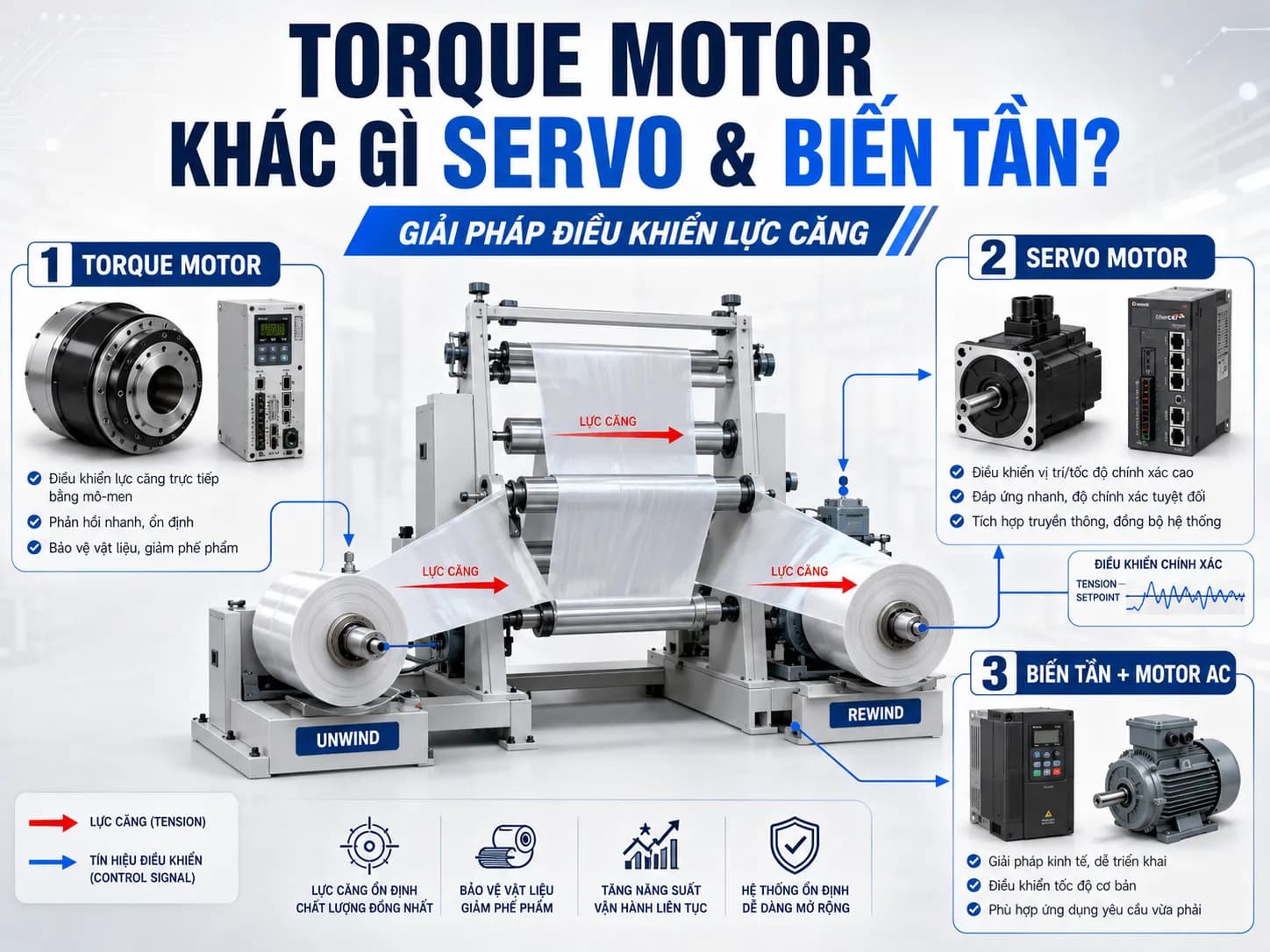
Torque motors, servo motors, and VFDs are all used in tension control, but they serve different purposes. Torque motors are ideal for simple winding/unwinding applications. Servo motors are best for high-precision, multi-axis synchronization. VFDs are suitable for AC motor systems, especially when integrated with torque control, load cells, dancer rollers, or dedicated winder/unwinder functions.
How Do Torque Motors Differ from Servo Motors and VFDs in Tension Control?
Torque motors, servo motors, and VFDs can all be used in tension control systems, but they are not the same. Torque motors are suitable for simple winding/unwinding machines that require torque control. Servo motors are suitable for machines requiring high precision and multi-axis synchronization. VFDs are suitable for systems using AC motors, especially when combined with torque control, vector control, load cells, dancer rollers, or winder/unwinder functions.
What is Tension Control?
Tension control is the process of maintaining a stable pulling force on web materials during winding, unwinding, or pulling through multiple machine rollers.
Materials that typically require tension control include plastic film, paper, fabric, foil, adhesive tape, wire, cable, and web-based materials.
If the tension is unstable, the material may wrinkle, tear, sag, experience edge misalignment, wind unevenly, or cause errors in printing, cutting, or labeling.
In winding/unwinding machines, the roll diameter changes continuously. As the roll radius changes, the required torque at the winding/unwinding shaft also changes accordingly.
Basic formula:
Torque = Tension × Radius
This means that to maintain stable tension, the system must adjust the torque according to the roll radius. Therefore, choosing a drive solution for a winding/unwinding machine cannot be based solely on kW or HP power ratings.
What is a Torque Motor in Tension Control?
A torque motor is a type of motor used to control torque or pulling force at the shaft. In winding/unwinding systems, torque motors are typically used for winding shafts, unwinding shafts, or scrap collection units when basic to medium-level tension control is required.
Torque motors are suitable for:
Film winding machines
Unwinding machines
Paper winding machines
Wire/cable winding machines
Scrap collection units
Medium-speed packaging machines
Simple tension control systems
The advantages of torque motors are ease of implementation, reasonable cost, and suitability for machines that do not require highly precise position synchronization. However, torque motors still require a suitable controller and thermal monitoring if operating for long periods under heavy load or at low speeds.
What is a Torque Geared Motor?
A torque geared motor is a torque motor combined with a gearbox. The gearbox helps reduce output speed and increase torque at the load shaft.
Torque geared motors should be used when:
Handling heavy material rolls
The winding shaft requires low speed
Higher output torque is needed
Pulling is required via couplings, pulleys, sprockets, or winding shafts
A direct-drive torque motor does not provide enough pulling force
Simply put: a torque motor is used for tension control; a torque geared motor is used when tension control is needed but additional torque is required after the gearbox.
Servo Motors in Tension Control
A servo motor is a high-precision drive solution, typically accompanied by a servo drive and feedback encoder. Servos can control position, speed, and torque, making them suitable for machines that require motion synchronization or precise multi-axis control.
Servo motors are suitable for:
High-speed packaging printing machines
Cut-to-length machines
Precision packaging machines
Machines requiring synchronization of pulling, printing, and cutting axes
Systems requiring material position control
Production lines with PLC or motion controllers
Applications requiring encoder, load cell, or dancer roller feedback
The advantages of servo systems are precision, fast response, and excellent control. The disadvantages are higher costs, more complex installation, and the need for tuning.
VFDs in tension control
A VFD is not simply a "speed adjustment" device in all cases. In winding/unwinding systems, a VFD can participate in tension control if the correct drive type is selected and configured properly.
At a basic level, a VFD controls the speed of an AC motor. However, in improved tension control systems, a VFD can operate based on:
Speed control
Torque control
Vector control
PID speed trim
Winder/unwinder function
Load cell feedback
Dancer roller feedback
Roll diameter calculation
PLC or tension controller
The key point is: not all VFDs are capable of effective tension control. If only a standard V/F VFD is used without tension feedback, the system is primarily just motor speed control, not precise tension control.
To use a VFD for tension control, priority should be given to drives with torque control, vector control, or winder/unwinder functions. For systems requiring higher stability, it is recommended to integrate load cells, dancer rollers, encoders, or a PLC/tension controller.
VFD configurations in tension control
Table 1: Common VFD configurations in tension control systems
Configuration | Suitability level |
|---|---|
V/F VFD + AC motor, no feedback | Suitable for basic speed control; should not be considered precise tension control |
Vector VFD + AC motor | Better speed and torque control than V/F |
VFD + load cell | Better direct tension control |
VFD + dancer roller | Maintains tension via dancer position |
VFD with winder/unwinder function | More suitable for winding/unwinding with diameter changes |
VFD + PLC/tension controller | Suitable for automated lines and higher requirements |
Comparison of Torque Motor, Servo Motor, and VFD
Table 2: Comparison of Torque Motor, Servo Motor, and AC Motor with VFD in tension control
Criteria | Torque Motor | Servo Motor | AC Motor + VFD |
|---|---|---|---|
Primary objective | Simple torque/tension control | Precise position, speed, and torque control | AC motor control via speed/torque depending on drive |
Accuracy | Medium to good | High | Depends on drive and feedback |
Cost | Reasonable | High | Medium |
Complexity | Low to medium | High | Medium to high |
Feedback | Not required in simple systems | Encoder, optional load cell/dancer | Requires load cell/dancer for good tension |
Strong applications | Simple winding/unwinding, scrap collection | Printing machines, cutting machines, high-speed machines | AC motor production lines, winder/unwinder |
When to use | Basic tension required, easy operation | High precision, multi-axis synchronization required | Speed/torque control with AC motor required |
Should you choose a Torque Motor, Servo, or VFD?
Choose a Torque Motor when:
Simple winding/unwinding machines
Basic tension maintenance is required
Operating speeds are not excessively high
Precise position synchronization is not required
An economical and easy-to-operate solution is desired
Choose a Torque Geared Motor when:
Handling heavy material rolls
Low shaft speeds are required
Higher output torque is needed
Transmission via gearboxes, pulleys, sprockets, or couplings is necessary
Choose a Servo Motor when:
The machine requires high precision
Multi-axis synchronization is required
Material position control is needed
High-speed printing, cutting, or packaging machines are used
A PLC or motion controller is present
Feedback from encoders, load cells, or dancer rollers is required
Choose a VFD when:
The system uses an AC motor
Line speed adjustment is required
A common, easy-to-maintain solution is preferred
The drive features vector control, torque control, or winder functions
Load cells, dancer rollers, encoders, or PLCs are available for tension feedback
Quick Selection Table by Application
Table 3: Recommended tension control solutions by practical application
Application | Recommended Solution |
|---|---|
Basic winding/unwinding machine | Torque motor |
Heavy rolls, low speed | Torque geared motor |
Scrap collection unit | Torque motor |
High-speed packaging printing machine | Servo motor |
Cut-to-length machine | Servo motor |
Traction shaft using AC motor | VFD |
Winder/unwinder using AC motor | VFD with torque control/winder function |
Line with load cell/dancer | VFD or servo |
Economical solution required | Torque motor or VFD |
High precision required | Servo motor |
Common mistakes when selecting a tension control system
1. Assuming a V/F VFD is sufficient for all tension control systems
V/F inverters can adjust motor speed, but without torque control, vector control, or tension feedback, they should not be considered as a precise tension control solution.
2. Underestimating the role of inverters in winders/unwinders
With a suitable drive featuring torque control, load cell/dancer, or winder functions, an inverter can be an excellent solution for many winding/unwinding systems using AC motors.
3. Using servo motors for overly simple machines
Servo systems are precise but involve higher costs and complexity. If the machine only performs basic winding/unwinding, a torque motor or a suitable inverter may be more economical.
4. Using standard motors instead of torque motors
Standard motors are not designed to operate as torque motors in applications requiring sustained torque or tension control. If used incorrectly, the motor may overheat quickly or fail prematurely.
5. Not calculating roll diameter
As the roll diameter changes, the required torque also changes. If the minimum and maximum roll diameters are not calculated, the system is prone to insufficient force or unstable tension.
MDriveTech provides tension control solution consulting
MDriveTech provides consulting for torque motors, torque geared motors, servo motors, inverters, geared motors, and drive solutions for winding/unwinding machines.
When selecting a solution, customers should provide:
Material type
Material width
Minimum and maximum roll diameter
Line speed
Required tension
Roll weight
Photos of the machine or old motor
Existing system: torque motor, servo, or AC motor + inverter
Presence of load cell, dancer roller, encoder, or PLC
Hotline: 0868 789 647
Email: [email protected]
FAQ – Frequently Asked Questions
How is a torque motor different from a servo motor?
Torque motors focus on torque and tension control. Servo motors provide more precise control over position, speed, and torque, making them suitable for machines requiring multi-axis synchronization or motion control.
How is a torque motor different from an inverter?
A torque motor is a motor designed for torque/tension control. An inverter is a drive used to control an AC motor. If the correct type with torque control, vector control, or winder functions is used in combination with a load cell/dancer, an inverter can participate in tension control.
Can an inverter control tension?
Yes, but it depends on the configuration. An inverter can control tension if the drive features torque control, vector control, or winder functions and is combined with a load cell, dancer roller, encoder, or PLC/tension controller. If only V/F without feedback is used, the system is primarily for speed control.
When should a torque motor be used?
Torque motors should be used for winding/unwinding machines, film winders, paper winders, wire winders, scrap collection units, or systems requiring basic tension maintenance.
When should a servo motor be used?
Servo motors should be used when the machine requires precise control, multi-axis synchronization, accurate cutting/printing positioning, or stable tension at high speeds.
When should a VFD be used?
A VFD should be used when the system utilizes an AC motor, requires speed or torque adjustment, and can be integrated with feedback sensors for better tension control.
When should a torque geared motor be used?
A torque geared motor is used when tension control is required, but the load demands lower speed and higher output torque.
Conclusion
Torque motors, servo motors, and VFDs can all be used in tension control systems, but the correct choice must be made based on machine requirements.
Torque motors are suitable for simple winding/unwinding machines. Torque geared motors are suitable when additional output torque is needed. Servo motors are suitable for high-precision systems that require axis synchronization and motion control. VFDs are suitable for systems using AC motors, especially when the drive features torque control, vector control, winder functions, and is integrated with load cells or dancer rollers.
Selecting the right solution helps winding/unwinding machines operate more stably, reduces material wrinkling and breakage, minimizes waste, and optimizes investment costs.